
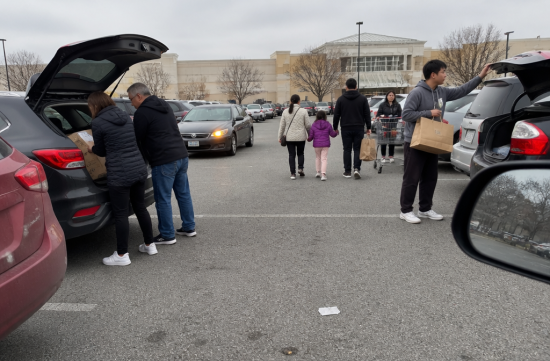
Every year, after Thanksgiving, driving around the Christiana Mall parking lot feels like a car license plate exhibition. Pennsylvania, New Jersey, Maryland, and sometimes even New York.
Meanwhile, here I am, holding a shopping basket, circling around because there's no parking. It feels like being the away team in my own home ground, you know?
The reason for this pilgrimage is simple. Delaware has no state sales tax and no local sales tax.
In the U.S., only five places have no state sales tax: Alaska, Delaware, Montana, New Hampshire, and Oregon. Among them, Delaware is the only one in the Mid-Atlantic region.
It becomes clearer when you look at the map. Maryland has a 6% tax, New Jersey has 6.625%, and Philadelphia adds a local tax of 2%, totaling 8%.
If you buy a $1,000 laptop in Philadelphia, you'll pay $80 in tax. In Delaware, that line doesn't even appear on the receipt.
Right there is the Christiana Mall, next to exit 4 on I-95. It opened in October 1978, and its website proudly states that all purchases are always tax-free.
The mall's general manager mentioned in 2012 that over 50% of customers come from other states. Although that number is a bit old, I verify it every year in the parking lot.
In 2013, there was even a report that the Apple Store here sold the most iPhones in the U.S. It was said by the staff, and Apple has never confirmed it, so you might consider it half a local legend.
Every time I see this scene, I feel a bit strange. I wonder if what people are excited about is the products or the absence of that one line on the receipt indicating tax.
Discounts seem like gifts from the stores, but tax-free feels like I've outsmarted the system. I think that little sense of victory is what drives people onto the highway.
But here comes the irony. The tax hasn't disappeared; it has just moved.
Delaware imposes a gross receipts tax on sellers instead of consumers. The retail tax rate is 0.7468%, and it's exempt for monthly sales up to $100,000.
This tax doesn't deduct the cost of goods. Even if there's no profit, if sales exceed the threshold, it must be paid, making it quite harsh for store owners.
The current framework was established significantly in 1975. That year, the taxation standard for retail stores changed to gross receipts, and service industries were included as well.
This past March, a state senator suggested replacing income tax with sales tax, which sparked quite a discussion. Ultimately, he had to clarify that he had no intention of proposing or supporting a bill.
Honestly, I prefer having no sales tax. The tax on the same vacuum cleaner feels heavier for families with tighter budgets.
Now, I have to share a bit of a buzzkill. If you're coming from another state, legally, that tax isn't over.
The Pennsylvania Department of Revenue provides an example. If you buy a desk in Delaware and bring it home, you have to pay a use tax.
New Jersey also cites a sofa bought in Delaware, and Maryland charges 6% on items purchased tax-free outside. This shows how much neighboring states are aware of Delaware.
What's even more interesting is clothing. Pennsylvania and New Jersey generally have no sales tax on most everyday clothing.
So if you came down to buy a puffer jacket from there, you gained nothing in terms of tax. There are taxable items like fur or accessories, but ordinary coats usually aren't taxed.
On the other hand, Maryland does impose taxes on clothing. However, if you drive from there, you'll need to pay $5 at the Newark tollgate for passenger vehicles.
A round trip of $10 means you'd need to buy about $167 worth of goods to break even with the toll, based on the 6% rate. I've excluded gas costs and the lost soul in the parking lot.
This year, the scene is a bit different. It's the first Black Friday season since Nordstrom, which had been there since 2011, closed its doors at the end of April.
Even with a 0% tax, the fact that department stores can leave feels somewhat lonely, doesn't it? The allure of something free doesn't seem to last forever.
If you're coming this weekend, just keep track of the time. The mall is open from 10 AM to 8 PM on Saturday and from 11 AM to 6 PM on Sunday, though hours may vary slightly by store.
If it were me, I'd skip Black Friday and go on a quiet weekday evening instead. There's no reason to stand in line on the busiest day when there's no tax all year round.
Still, I don't completely dislike that hustle and bustle. Seeing different accents and faces standing in the same line enjoying the same zero feels quite fair.
What about you? Is what we want to save by crossing state lines really just money, or is it the feeling of having won?
 mintcitytraveler1973




 Doori Ark |


 Live and that's it |


 Generation X |









 Life in the US |

 happy 9 |
 aloeverame |

 some fame |

 Yo Lock Me Up |
 Entering Art Directly |
 Mini Mee |
 Exciting chichichi |
 My Circle |
 Fun Flex Life |
 dermoon |
 Starbucks Reserve Roastery Closure |
 Noodle Noodle |
 Round and Round Children's Song Kingdom |
 Exciting FM Radio |
 vexon87 |
 Helpful Life Stories |
 leaves |
 glenview 89 |
 Wang Ga Nae |
 Alright Twain |
 cloud0 |
 Allaston New Yorker Notebook |
 MBTI Detective Agency |