
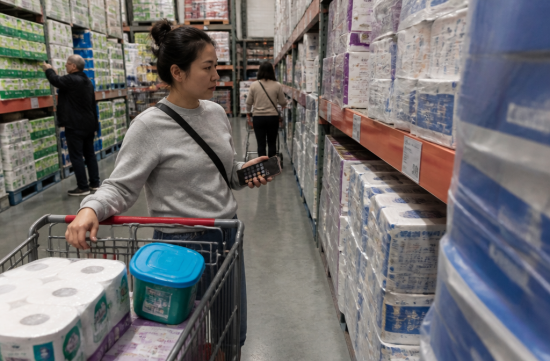
Have you ever found yourself sitting in front of the TV during Black Friday, only to come away empty-handed? These days, I start by adding toilet paper and detergent to my cart. Since I need to buy them anyway, getting them at a discount is real saving.
However, relying solely on sale tags for essentials can lead to missing out on better deals. Today, I'll outline the remaining schedule, price comparisons, and storage tips in order.
First, let's talk about the schedule. Even if you missed Black Friday yesterday, it's not too late.
The Amazon Black Friday Week and Cyber Monday events start on November 19 and run until the 30th. On the 30th, new deals will be released at midnight and again at 8 AM Pacific Time.
The Walmart Black Friday event lasts until the 29th, and Cyber Monday runs from the 30th to December 2nd, online only. It starts at 12:01 AM Eastern Time, which means it's 9:01 PM on Sunday night here in California. If you wait until Monday morning, you'll be too late.
Target's Black Friday sale ends on the 29th. While preparing this article, I found that the Cyber Monday date isn't officially listed, so it's best to check the app for accurate information.
Costco is a bit different. Their in-store discounts are from November 16 to December 20, so there's no need to line up this weekend.
Let's look at the items. Bounty Advanced paper towels are discounted by $5.60 for a pack of 12 rolls, and you can buy up to two packs.
For detergent, Tide Free & Gentle PODS (152 count) is $6 off, and Tide Ultra OXI PODS (100 count) is $5 off. Both have a limit of two.
For baby products, Huggies Pull-Ups Plus and Pampers Easy Ups Ultra are both $8 off, with a limit of three per size.
However, these are training pants. I couldn't find discounts for band-style diapers or toilet paper on the promotional screen, so be sure to check in-store.
Honestly, I want to point out that even reading Amazon's official Black Friday announcement, there are no specific discounts mentioned for detergent or diapers.
The big promotions seem to focus on kitchen appliances and vacuum cleaners. So, knowing the regular prices for essentials is crucial to spotting real deals.
So, what should you compare? The answer is unit price. Forget about package size or discount percentages for a moment.
For detergent, divide the total price by the number of loads. For example, if it's $18 for 100 loads, that's 18 cents per load; if it's $12 for 60 loads, that's 20 cents, making the seemingly cheaper option actually more expensive.
For toilet paper, look at the price per square foot instead of the number of rolls. Names like Mega or Double vary by brand, making comparisons difficult.
For diapers, consider the price per diaper. Even if the total price is the same, larger sizes come with fewer diapers in the box, so always compare within the same size.
Don't forget about taxes. In California, baby diapers have been exempt from sales tax since 2020.
I think this is a really good policy. Adding tax to essential items can be tough for families on a budget.
On the other hand, toilet paper, paper towels, and detergent are taxable items. In Anaheim, the tax rate is 7.75%, so if you fill your cart with $100 worth, that's an additional $7.75.
You also need to consider the types of coupons. If you use manufacturer coupons on taxable items, the tax is calculated on the pre-discount price, so don't be surprised if the total at checkout differs from your expectations.
If you're shopping online, check out Amazon Subscribe & Save. If you set up five regular deliveries to the same address, you'll get an additional discount, and you can cancel anytime.
However, prices aren't fixed. The next delivery will be calculated at the price on the day the order is processed, so when you receive the notification email, check the amount, and if it's gone up, skip it.
If the Prime membership fee is a concern, there's also Prime Access. For those receiving government assistance or verified income, it's $6.99 instead of $14.99 per month.
What if you buy something at Target and the price drops later? Target has a Holiday Price Match policy that matches their own prices if they drop before December 24. This doesn't apply to competitor prices, and there are exclusions, so keep your receipt.
Now, how much should you stock up? According to Gain, capsule detergent should be used within six months of purchase, and liquid detergent should be used within six months of opening. These aren't items you should stockpile for a year.
For diapers, based on Pampers, if unopened, they should be used within three years from the manufacturing date, and within 12 months once opened. The challenge is that babies grow faster than the expiration date, so it's safer to buy a little of the current size and mix in the next size.
And many of you probably store items in the garage, right? Pampers recommends avoiding humid garages or attics and keeping them in a cool, dry indoor space.
If it were me, I'd buy detergent and paper towels at Costco within the limits this weekend, and compare the per-diaper prices at Walmart on Sunday night and Amazon on Monday. For toilet paper, I'd only buy a three-month supply from the cheapest option.
To summarize, check the timing, calculate unit prices, and buy only what you'll use. I find this simple shopping cart much more reassuring than flashy doorbusters!
 RocketMan







 Healthy Local Fresh Information |
 Round and Round Children's Song Kingdom |

 Lifestyle Information Search USA |

 My Love DS |

 U.S. Weather Bureau News |






















 biscuitz |
 Scade Studio |

 Nevada Vegas UNLV |

 Things to know |
 West Kong |
 Entering Art Directly |
 Mini Mee |
 Exciting chichichi |
 My Circle |
 Fun Flex Life |
 dermoon |
 Starbucks Reserve Roastery Closure |
 Noodle Noodle |
 Exciting FM Radio |
 vexon87 |
 Helpful Life Stories |
 leaves |
 glenview 89 |
 Wang Ga Nae |
 Life in the US |
 Alright Twain |
 cloud0 |
 Allaston New Yorker Notebook |
 MBTI Detective Agency |