
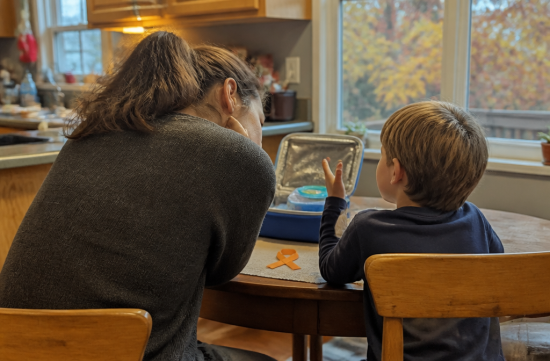
At the dinner table, my child was picking at their food when they suddenly spoke up. A friend said their lunchbox smelled strange. They laughed as if it was no big deal, but that laugh seemed a bit awkward.
October was approaching. In the United States, October is recognized as National Bullying Prevention Month.
This campaign was started in 2006 by the National Bullying Prevention Center under the PACER Center. The aim was to change the perception that bullying is a rite of passage that children experience as they grow up.
This year's main event, Unity Day, is on Wednesday, October 21. The key is to wear orange clothing or accessories to school on that day.
I really like the idea that orange can spark conversations. I plan to make orange ribbons with my child.
However, when it comes to Asian children, the numbers get a bit complicated. According to a 2022 survey by the National Center for Education Statistics (NCES), 19% of students aged 12-18 reported being bullied at school during the 2021-22 school year.
In the same survey, Asian students reported a rate of 9%. On the surface, that seems low.
But another survey shows a completely different picture. A nonprofit organization, Act To Change, asked over 300 Asian youth in 2021, and 80% reported experiencing bullying, either in person or online.
The two surveys differ in their subjects and methods, making direct comparisons difficult. However, one striking statistic stood out.
In the same Act To Change survey, the percentage of Asian students who reported bullying to an adult was 38%, while for non-Asian students, it was 63%. This made me think that their silence might mean they are less visible in the statistics.
I wonder if children might hesitate to speak up because they fear their parents will find it troublesome to contact the school or worry that it might escalate the situation. Just thinking about that is heartbreaking.
My child was just like that. It was only after a long time that they casually mentioned it at the dinner table.
So the first thing to do is create an environment where your child feels comfortable talking. Instead of probing, I lightly ask what the worst moment of their day was.
If they open up, I first reassure them that it's not their fault. Whether it's about their lunchbox, their appearance, or how their name is pronounced, it's important not to look for reasons for the bullying within the child.
Next is documentation. Write down the date, location, what was said, and if there were any witnesses.
If it's online bullying, make sure to take screenshots. This documentation will be very helpful when discussing the issue with the school later.
West Virginia has a state law (W. Va. Code 18-2C-3) that requires each county board of education to have a bullying prevention policy. This must include reporting procedures, investigation procedures, parental notification, and measures to protect the victim and prevent retaliation.
There is also a provision that requires school staff to report any knowledge of bullying. This applies not only within the school but also on school buses, at bus stops, and during school events.
So it's a good idea to organize your records and send them to the homeroom teacher via email. It's easy for things to get lost in conversation, so I always make sure to put it in writing.
You can check the exact wording of our county policy on the school district's website. Also, ask if the school has a separate reporting form.
If the school's response is lukewarm, there are further steps to take. Bullying based on race or national origin can be a violation of federal civil rights law Title VI.
In this case, you can file a complaint online with the Office for Civil Rights (OCR) at the U.S. Department of Education. You must file it within 180 days from the date of the discrimination, so be sure to keep track of the dates.
Of course, I'm not suggesting you start a fight right away. I believe it's best to resolve things calmly with the school if possible.
At home, practice short responses that your child can use. Something like, "That's just our family's food, do you want to try some?"
Making it a game, like role-playing, helps the child feel much more comfortable. Also, let them know that if they feel stuck, they can just walk away and go to an adult.
It's also good to talk about what to do if your child is a bystander. Just walking alongside a friend who is being bullied is a courageous act in itself.
After that, we sent some extra kimbap for my child's friends as part of their lunch. The next day, my child came home excited, saying their friends thought it was delicious.
Not every situation will resolve this way. Still, it was significant for my child to experience that their culture could be something to share rather than something to be bullied about.
If it were me, I would send my child to school wearing orange on Unity Day and make sure to listen to their school stories that evening. I believe that preventing bullying starts with having an adult nearby who encourages the child to speak up.
 vibeseawalker1998








 morvex37 |
 Ari Songhan American Immigration Life |
 Bearded Strawberry Smoothie |
 Heart Ticker |
 Duck Duck Go |
 Bridgo |

 Freedom Yea |
 Gomex Korea |
 Oz's Wow Company |
  Watanaka Karametibaksa |
  castle |
  xelton52 |
  carefree |
  vrixen73 |
  AZ Road Master |
  Victory 1988 |
  summita |
  business lim |
  Colorado Lee |
  Make My Day |
  Fros Pro |
  lioness |
  La Bean |
  American History This and That |
  Monte Sori |
  U donn |
  Sarah's Blog |
  Holy Cow |
  monster |