
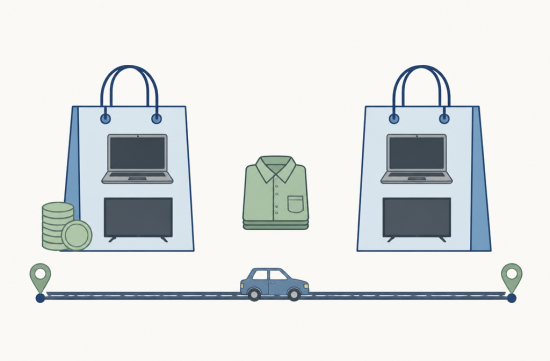
As Black Friday approaches, there's a common saying that comes up: "I should go to Delaware again this year." The idea is that shopping in a tax-free area is always a win.
I used to believe that too, until I started breaking down the numbers. It turns out it's not as simple as it seems. Today, I want to go through that calculation with you.
First, let's clarify the basic figures. The sales tax in Philadelphia is 8%. This consists of a 6% Pennsylvania state tax and a 2% Philadelphia local tax.
In Delaware, the sales tax for consumers is 0%. The price scanned at the register is the final price.
However, Delaware imposes a gross receipts tax on business revenue. While it doesn't appear separately on the receipt, it's good to know that it counts as a cost for the store.
That's why places like Christiana Mall are famous for attracting shoppers from neighboring states. It's easily accessible via I-95, making it convenient for many people from Philadelphia to visit.
At this point, shopping in Delaware seems like a guaranteed win. But there's a first catch: clothing.
In Pennsylvania, there is no sales tax on general clothing and shoes. Not only is the 6% state tax exempt, but the 2% Philadelphia local tax is also waived.
This means that traveling to Delaware to buy a coat or sneakers results in zero tax savings. You wouldn't pay tax even if you bought them in Philadelphia.
Of course, there are exceptions. Formal wear like suits, jewelry, and items like backpacks are taxable in Pennsylvania. For ambiguous items, it's best to check the state tax department's resources for accuracy.
The real difference comes with items like electronics, appliances, and furniture. Here, the 8% tax translates directly into a price difference.
For example, a $1,200 laptop would incur $96 in tax in Philadelphia. A $500 TV would have a $40 tax. The larger the purchase, the more significant the difference becomes.
Now, here's the second catch. Pennsylvania has a use tax. This means that if you buy an item tax-free from another state and bring it into Pennsylvania, you are required to pay that tax.
The Pennsylvania Department of Revenue even provides examples of this. If you buy a desk in Delaware and bring it home, you must pay the use tax.
The rate is the same as the sales tax. With a 6% state tax and an additional 2% local tax for Philadelphia residents, it ultimately totals 8%.
You can report this on your annual PA-40 personal income tax return or through myPATH. Essentially, if you save on taxes in Delaware, you might end up paying them later.
Honestly, I wonder how many people actually report this diligently. However, knowing the regulations, calling it "savings" isn't entirely accurate.
So, does that mean shopping in Delaware is pointless? Not at all. Each store has different Black Friday stock and deals, and there's value in going out just to browse.
The fun of spending a day with family is something that can't be quantified.
However, you must factor in travel costs. This includes gas, time, and lunch expenses.
There's a simple formula: divide your travel costs by 0.08 to find out how much you need to spend to break even.
If you estimate your travel costs at $30, you would need to buy $375 worth of taxable items just to break even. If it's $50, then you'd need to spend $625. This assumes you're not paying any use tax.
On the other hand, if you buy a $1,500 appliance, the tax difference would be $120. At that point, it's clear that you would still come out ahead even after accounting for travel costs.
Just remember to exclude clothing and shoes from your calculations. Since there's no tax on them, they can't factor into your break-even analysis.
Also, don't overlook traffic congestion on Black Friday. Spending 30 minutes searching for parking at the mall is a cost in my opinion.
Consider online shopping as well. Major online retailers collect taxes based on the shipping address, so if you have it shipped to a Philadelphia address, the 8% tax will still apply.
Ultimately, the pure benefit of traveling to Delaware becomes clear only when you make large purchases of taxable items. If you're just going for a few small items, you're essentially just spending on gas.
This year's Black Friday is on November 27. Before you head out, I recommend dividing your shopping list into taxable and non-taxable items.
If it were me, I would buy clothes and shoes in Philadelphia. For larger appliances, I would compare prices first, and if the deals in Delaware are significantly better, then I would go.
And I would keep my receipts. Whether I report the use tax or not, it's important to keep track of what I bought and how much I spent.
The idea of 0% tax is appealing. But when you follow the numbers all the way through, true savings depend more on what you buy than where you buy it.
 RapidStone98

 novent |
 Silent Sea |
 Pointy |
 Idaho's Sumi's House |
 holy cheese |
 festive |
 Pennsylvania Information News |
 heartwarming |
 DelphiaMo |

 Medical Latest Trends News |
  castle |
  xelton52 |
  carefree |
  vrixen73 |
  AZ Road Master |
  Victory 1988 |
  summita |
  business lim |
  Colorado Lee |
  Make My Day |
  Fros Pro |
  lioness |
  La Bean |
  American History This and That |
  Monte Sori |
  U donn |
  Sarah's Blog |
  Holy Cow |
  monster |
  houston mama |