
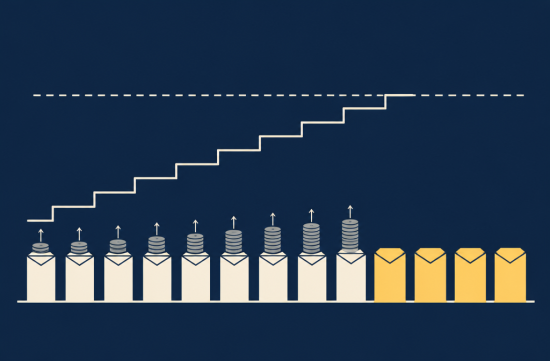
Have you heard about the magic of suddenly getting a higher year-end salary when your annual income is high? It's not magic; it's about Social Security taxes.
Starting next year, this magic will begin a bit later. The Social Security tax cap will rise to $192,300 in 2027.
This figure was released alongside the SSA's announcement of a 3.6% cost-of-living adjustment (COLA) for 2027 in October. The cap for 2026 was $184,500, so that's an increase of $7,800.
The tax cap refers to the maximum income subject to the 6.2% Social Security tax. Any salary exceeding this amount will not be subject to this tax.
Therefore, the maximum Social Security tax an employee will pay in 2027 is $11,922.60. In 2026, it was $11,439.
The difference is $483.60. For high earners, it might seem like, "Oh, that's not a big deal, right?"
However, for self-employed individuals, the situation is a bit different. They have to pay both the employee and employer portions, resulting in a tax rate of 12.4%.
Calculating this, the maximum burden for self-employed individuals in 2027 will be $23,845.20, which is an increase of $967.20 from 2026. Ah, they say being a boss gives you freedom, but taxes double your freedom too.
Now, the real question is when and how salaries will change. Let's consider an employee with an annual salary of $240,000, receiving $20,000 monthly.
This person will have $1,240 deducted for Social Security each month. Once their cumulative salary exceeds the cap, this deduction stops.
In 2026, the cap was $184,500, and they exceeded it in early October. In 2027, with the cap at $192,300, that threshold will be pushed back to the latter part of October.
As a result, the "month when the salary increases" will come, but it will feel slightly delayed. If you had planned your year-end shopping around that money, you might want to recalculate. If you receive bonuses or stocks throughout the year, that could also advance the point at which you hit the cap.
On the other hand, if your annual salary is below $192,300, this cap increase does not directly affect your salary. Those who have been paying 6.2% all year will continue to do so next year.
Many people get confused about Medicare taxes. The 1.45% Medicare tax has no cap, so it applies regardless of income.
Additionally, there is an extra 0.9% Medicare tax on income exceeding $200,000 for individuals. So even if Social Security stops, deductions won't be zero.
For example, if your annual salary is $240,000, an additional 0.9% will apply to the $40,000 exceeding $200,000. This is automatically deducted by the employer.
If you work in California, you also need to consider SDI. Starting in 2024, SDI will have no cap and will apply to all wages.
The SDI withholding rate for 2026 is 1.3%. The rate for 2027 has not yet been confirmed by EDD at the time of writing, so it's best to check the EDD website at year-end for accuracy.
For those working two jobs, there's another trap. Each company calculates the cap separately for tax deductions.
If the combined salary from both jobs exceeds the cap, it means you've paid more Social Security tax. You can claim this back as a credit during next year's tax filing, so make sure to keep both W-2 forms. Companies do not coordinate this automatically.
By the way, companies also bear the same 6.2% tax up to the cap for employees. Therefore, companies with many high-salary employees will need to budget a bit more for labor costs next year.
So, do high earners only lose out? Not necessarily.
Income paid up to the cap is reflected in future Social Security retirement calculations. The more you pay, the higher the recorded income.
Of course, the formula for retirement benefits is designed to provide a lower return rate for high-income brackets, so you won't receive exactly what you paid. Still, it's not entirely wasted money.
In summary:
The cap has increased by $7,800. The maximum burden for employees has risen by $483.60. For self-employed individuals, it has increased by $967.20.
Additionally, Medicare and SDI continue to be deducted without a cap. Just remembering these three points will help you feel less confused when looking at next year's pay stub.
In fact, there are ongoing discussions about completely eliminating the tax cap. The logic is that if high earners pay more, it would solve the fund depletion issue.
My perspective is a bit different. While raising or eliminating the cap seems like an easy solution, if discussions about restructuring the fund itself don't happen alongside it, the burden on working individuals will ultimately increase.
That topic is lengthy, so I'll save it for another time. What you can do right now is calculate when your salary will exceed the cap based on your earnings.
I would check the cumulative deduction amount with the payroll department or payroll app at the beginning of the year. Instead of treating the increase in year-end salary like a bonus, I find it more comforting to put it directly into a savings account.
 BenzPalace
 MellowSky71








 neroyo |

 American Food Information & Calories |

 Bald Eagle Brothers |

 sunny side |

 kodak |

 Chino Min |

 DREAM BIG |

 Shoot Me |

 Cap Com |

 Raccoon Ramen Night |
 strawberry |
 US Regional Information Local News |
 USA Business News |
 Blondee |
 E whisper |
 Potato House |
 freshmint |
 Ansaso |
 Golado |
 babybay |
 honeycom |
 French Macarons |
 Exploring American Life Information |
 Sunshine Blog |
 Community Cross |
 Sayonara H |
 What can make money? |
 Information Search LifeMAN |
 morvex37 |
 neontrail |