
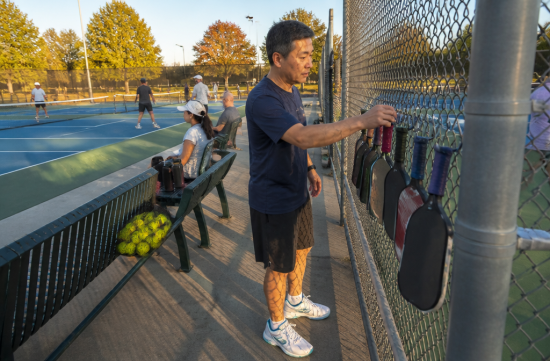
Last weekend, I was sitting on a bench next to the court in the local park when I saw someone I didn't recognize walk straight into an empty court with paddles in hand. There were already four paddles hanging on the fence.
Soon, someone said, "Hey, there's a line," and the person turned red and came out. They probably had no ill intentions; they just didn't know.
These days, many people around me are eager to start playing pickleball. So today, I'll summarize some court etiquette and equipment tips to help you avoid embarrassment on your first day.
First, let's talk about the paddle queue. In open play, instead of people lining up, it's common to hang paddles on the fence or a rack to indicate the order. This is called paddle stacking.
The issue is that each court has different rules. Some courts allow the winning team to stay, while others require all four players to leave after a game.
So, when you visit a new court, it's best to ask. Just say, "How does the rotation work here?" and everyone will kindly explain.
Make sure to write your name on your paddle. Surprisingly, many people use the same model, so it's common for the order to get mixed up.
There are also a few etiquette rules during the game. If a ball rolls onto your court from the side, immediately shout "Ball on!" and stop play.
This is not just a matter of courtesy; it's a safety issue. If you step on a ball and fall, you could seriously injure your ankle or wrist.
If a line call is unclear, it's an unwritten rule to call it in favor of your opponent. If you're not sure, assume it's in.
Remember to memorize one rule: the area in front of the net on both sides, known as the kitchen or non-volley zone, must not be stepped into when hitting the ball without a bounce; doing so is a fault.
This is the most common mistake beginners make. If you're confused about how to keep score, just follow the server, who will call out the score.
At the end of the game, whether you win or lose, go to the net and tap paddles to greet each other. I really like this culture.
And one more thing: it's best to refrain from unsolicited coaching. Even if it's well-intentioned, your opponent might feel disregarded.
Conversely, if you're a beginner, it's more comfortable not to expect experienced players to teach you. If there's a significant skill gap, consider looking for lessons or beginner clinics first.
Now, let's talk about equipment. Paddles must be no more than 24 inches in combined width and length, and no longer than 17 inches.
If you plan to compete, check if your paddle is on the USA Pickleball approved paddle list. This list changes frequently, and some models may be approved one day and removed the next.
If you're just playing casually, there's no need to buy expensive paddles right away. It's fine to play for a few months and figure out your style before making a change.
There are different balls for indoor and outdoor play. Indoor balls typically have 26 large holes, while outdoor balls usually have 40 small holes.
Outdoor balls are heavier and sturdier, making them less affected by the wind. However, they tend to be louder and break more easily.
If you use an indoor ball on an outdoor court, it will get blown around by the wind, making rallies difficult. It may seem minor, but others playing with you will notice right away.
What I want to emphasize most is footwear. Running shoes are designed for forward movement and don't provide enough ankle support for quick lateral movements.
Wear shoes that offer lateral support, like tennis shoes or court shoes. Most of the pickleball injury stories I've heard involve ankle sprains or falls.
Don't skip warm-ups either. Many people fall when they suddenly step back, so it's better to develop the habit of moving sideways instead of backward.
If you have existing knee or back issues or are on blood pressure medication, I recommend consulting with a doctor or pharmacist before starting. The intensity of the exercise can be higher than expected.
Find out where you'll be playing in advance. The city's Parks and Recreation page often lists free outdoor courts and paid indoor courts.
In my neighborhood, there's a park with a net installed, and another park where you have to bring your own net and ball since only the lines are drawn on the ground. I often see people who didn't know this leaving empty-handed.
Some indoor courts at recreation centers for those over 50 can be used for a daily pass of $8. This is a pretty good option for those who find the summer heat overwhelming.
In summary, on your first day, a pair of court shoes, a few outdoor balls, and the phrase "How does the rotation work here?" are all you need.
Pickleball is a sport that is remembered more for its etiquette than skill. A beginner who lines up well and greets others will be welcomed at any court. If I were you, I'd focus on that for the first month.
 SunnyLoneStar
 skyvalleycreator1968







 Anjollinya Blog |

 Kitchen Ideas |

 Spaghetti Flying Religion |

 Giant Squid and Sweet Potato Soup |

 choi family |
 BIODOCTOR NEWS |

 nexaro |


 orvian89 |

 Mental Health Psychiatrist |
 ssome |
 skykong |
 Shining Our Own World |
 gardener 007 |
 golfmaster |
 Nanana Nanana Nanana |
 Who's watching? |
 endone |
 RockStar |
 Casa Mia |
 You Only Live Once |
 Hardworking CPA |
 Joyce 77 |
 Runner Kim |
 My Town My Way Blog |
 My Miami Stories |
 Entip |
 Tony Park |
 Jean Claude Bundang Blog |
 DJ DC BLOG |