
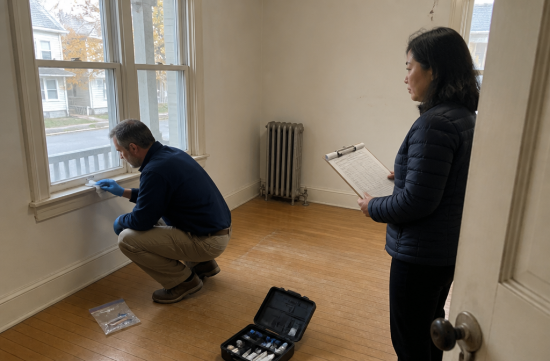
These days, one question I hear most often from landlords during consultations is, "Do I need to get a lead paint inspection again if the tenant is moving out this month?"
To answer that, if the rental was built before 1978 and there is no valid certificate, it is necessary to have an inspection before accepting a new tenant. Especially this fall, you should definitely double-check this.
The law in question is New Jersey state law P.L.2021, c.182. It went into effect on July 22, 2022, and the Department of Community Affairs (DCA) has set detailed standards under the regulation N.J.A.C. 5:28A.
The target properties are single-family, two-family, and multi-family rental units built before 1978. The year 1978 is significant because it was when the sale of residential lead paint was banned in the U.S.
The deadline for the first inspection was July 22, 2024. If a tenant changed before that date, that was the deadline.
The issue arises afterward. After the first inspection, inspections must be conducted every three years or whenever a tenant changes, whichever comes first.
However, there is one exception. If you have a valid lead-safe certificate, you do not need to have a re-inspection even if the tenant changes.
One thing that many people overlook is the validity period of the certificate. A lead-safe certificate is only valid for two years from the date of issuance.
So, if you had an inspection done to meet the summer 2024 deadline, it is likely that the certificate expired around this summer. This is why I emphasize this fall.
If the certificate is expired and the tenant changes, a new inspection must be conducted. The DCA also advises that a new inspection is required before changing tenants if the certificate has expired.
Inspections cannot be done by just anyone. They must be conducted through a DCA-certified lead assessment company or an inspector designated by the town, and private inspectors must have a state health department license.
When choosing a company, first check the list of certified companies on the DCA website. Inspections done by companies not on the list are unlikely to be recognized for certification.
The inspection methods vary by neighborhood. Towns with a child blood lead level increase rate of less than 3% can conduct a visual inspection, while those with 3% or more must perform a dust wipe test.
You should also carefully consider the costs. The inspection fee varies significantly depending on the company and method, so it is advisable to get estimates from two or three places. In addition to the inspection fee, there is a state fee of $20 per unit, which goes into the state's lead hazard management support fund.
This $20 is not a one-time fee; it is charged again for each inspection per unit. Additionally, there are town administrative fees and company inspection fees, so if you have multiple units, the total can be higher than expected.
If lead hazards are found during the inspection, a certificate will not be issued. The landlord must first address the issues through abatement or other state-recognized hazard management methods.
What happens if you ignore this? If you do not comply with the regulations, you could face fines of up to $1,000 per week until the inspection or repairs begin.
Even delaying by a month could result in over $4,000 in fines, so honestly, saving on inspection costs is not worth it.
Let me summarize the exemptions. Buildings constructed after 1978 and units that have already received lead-free certification are not subject to this requirement.
Seasonal rentals that are rented for less than six months a year are also exempt, as long as there are no continuous renewals. Multi-family buildings that have been registered for over ten years and have passed inspections without paint violations may also be exempt.
Receiving a certificate does not mean the process is over. Landlords must attach a copy of the certificate to the lease agreement and provide it to the tenant.
Records of the certification with the tenant's name must also be kept, and there may be cases where you need to inform the town that the tenant has changed.
So, here's the order I recommend. First, check the county property records to see when the house was built.
Next, check the issuance date of the certificate you have. If two years have passed, it has expired.
And when you receive notice that the tenant is moving out, schedule the inspection right away. It's easier to schedule when the house is vacant right after the tenant moves out, and if any issues arise, you'll have time to make repairs.
Finally, directly ask our town's building or health department about the fees and inspection methods. Even within New Jersey, ordinances and amounts can vary slightly by town.
If you are a tenant, make sure to check if a copy of the lead-safe certificate is attached when signing the lease. This is especially important for families with young children.
At first, these regulations may seem cumbersome. However, considering the many old homes in New Jersey and the direct impact on children's health, I believe this system is reasonable.
This article is based on the official DCA guidelines as of October 2026. If it were me, I would check the certificate a month before changing tenants.
 ShabuBattle








 |
| 
 Premium Gas Camp |
 CA Real Estate |
 cheesepup |
 breezem |
 Margarine Daebimama |
 Google Idea |
 yogurt mania |
 eatontown blog |
 Okay Electronics Information |
  nixxon |
  kevin Kim |
  beerdreamer |
  Kims Spring |
  White bunny |
  Kansas City Representative Singer |
  shadow 007 |
  sun walker |
  Choco Choco Star |
  midnight blue |
  honeypot |
  summer |
  adventure77 |
  flexible |
  Shintongbangtong Shin Naerin James Park |
  truepixel |
  Kathy's Blog |
  Hae Naem |
  quatspace |
  Marisol |