

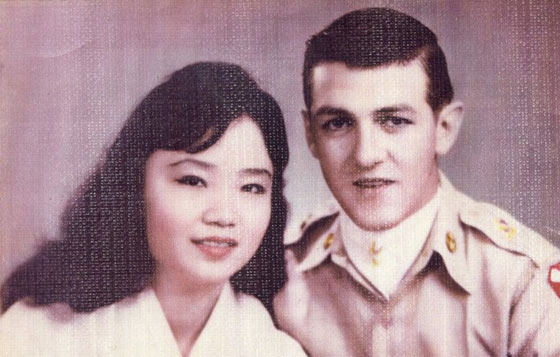
A few days ago, I couldn't sleep at night and while searching on my phone, I suddenly became curious about "women who married American soldiers during the Korean War."
I had heard of war brides, but I had never thought deeply about it.
However, it turned out that this story was not just a simple love story.
It was a very intense, sad, and dark piece of American history.
The Korean War lasted from 1950 to 1953, during which many American soldiers were deployed to the Korean Peninsula. Even in the war zone, people fell in love.
Especially during such a poor and chaotic time, many Korean women formed relationships with American soldiers, and some even got married.
These women are referred to as 'war brides.'
But here's a shocking fact.
In some states in the U.S. at that time, 'international marriage,' to be precise, 'marriage between whites and non-whites' was illegal.
Even marriages between white men and Korean women were often not legally recognized when they returned to the mainland U.S.
Why was that?
Why did the U.S. prohibit interracial marriage until 1967?
Upon researching, I found that many states in the U.S. had laws known as Anti-Miscegenation Laws since the 19th century.
These laws legally prohibited whites from marrying individuals of other races.
Not only African Americans but also Asians, Native Americans, and Latinos were all included as 'non-whites.'
In other words, Korean women were included as well.
Even until 1967, a staggering 16 states maintained such laws, so the free and open America we imagine was only created quite recently.
It was only through the 1967 case of 'Loving v. Virginia' that the U.S. Supreme Court ruled that "prohibition of interracial marriage is unconstitutional."
It's hard to believe that this was an event of the late 20th century.
What was life like for Korean women who went to America as war brides?
Upon further research, I found that thousands of war brides entered the U.S. during the Korean War, and later, up to 100,000 Korean brides came to America, but they faced discrimination similar to that experienced by other minority and immigrant groups.
They experienced social stigma and prejudice comparable to that of European war brides after World War II.
Some women lived in rural areas completely alone without a single other Korean.
Still, there were those who gave birth, put kimchi on the table, and bravely adapted.
The important fact is that Korean war brides started new lives in America, and some even acted as sponsors for their families' immigration from Korea.
In an interview I saw, an elderly woman said this.
"I followed him because I loved him. But when I got there, I realized that love alone can be very lonely..."
After reading this, I was lost in thought for a while.
Those women who lived in a foreign land with nothing but love felt remarkable, and I thought about how 'love was political' in that era.
It truly existed that nationality and skin color were conditions for marriage.
Nowadays, it seems that nationality and race are not very important, but the fact that just 60 years ago, they were barriers to marriage weighs heavily on me.
The stories of Korean war brides are also stories of our mothers' generation and serve as a record of how much the freedoms and rights we enjoy today are built upon the suffering of many.
A brief history encountered through a search.
But I think it will remain in my memory for a long time.




 Toaster Pizza Magic Show |
 US Embassy |
 fortbliss |
 Folding Instructions |
 yentra |
 squidogame |
 Margarine Daebimama |
 eatontown blog |
 cloudyday |
  Google Idea |
  Gorama Round |
  Skydiving |
  dreamport |
  Yellow Snowman |
  velvetnom |
  Anytime Journey |
  Mrs. Duluth |
  jaxter |
  Atlanta Mama |
  Baguette Blog |
  Korean Mom |
  My NYC |
  moo moo |
  Mr Oh |
  forevergee |
  festival |
  manchester |
  constant |