

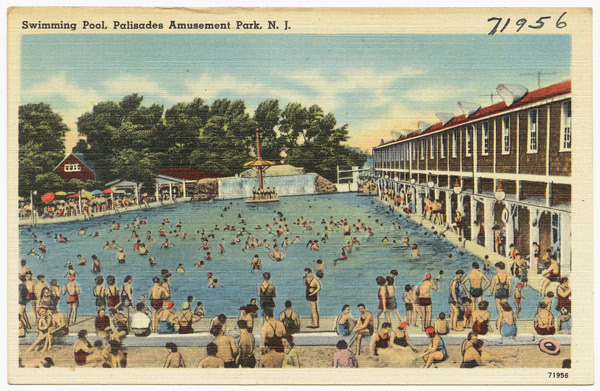
In the 1930s, New Jersey had a place that was always crowded with people during the summer, and that was the 'Palisades Amusement Park'. Located on a cliff facing the Hudson River, this park was a symbol of a 'dream summer vacation' for Americans at the time.
The summer heat of the 1930s, when air conditioning was not yet widespread, was truly unbearable. Working-class families and immigrants from New York and New Jersey crossed the Hudson River to head to Palisades Park to escape the city's heat for a while. There was a massive circular swimming pool there, which was enormous in size.
Promotional posters at the time featured the phrase "World's Largest Outdoor Saltwater Pool". It was a saltwater pool created by drawing in seawater, so the water quality was special, and the experience of swimming on the cliff with the river breeze was truly unique.
The swimming pool was not just a place for water play. Music flowed, diving shows were held, and at night, lights danced on the surface of the water. Events like swimsuit fashion shows were often held, and local beauty contests and radio broadcasts took place here as well.
Young people danced beside the pool, and families enjoyed sandwiches under the shade of trees, spending their summer moments. It seemed as if the optimistic spirit of the people at that time, who said, "We will not lose our leisure in the shadow of the New Deal and industrialization," gathered here.
This swimming pool also reflected a facet of social change at the time. Initially operated as a facility centered around white people with racially discriminatory restrictions, it gradually transformed into a space where various races and classes gathered together. This place became not just an amusement park, but a cultural exchange venue for the New York metropolitan area. The pool was crowded with huge crowds in the summer, and celebrities would come to relax.
At that time, the Manhattan skyline could be seen across the Hudson River, and the laughter of children echoed from the pool. Young men shouted with excitement as they jumped into the water from the diving board. Music flowed from the radio speakers, and women wore polka dot one-piece swimsuits, tying scarves around their heads to shield themselves from the sun. For the people of that era, this place was probably a little paradise that made them forget their worries of reality.
However, this glorious era did not last forever. In the 1950s, as new amusement parks emerged, the popularity of Palisades Park gradually declined. In 1971, after the last summer season, the park closed its doors. Now, apartments and parks stand in its place, but in the summer, it still seems like the sounds of splashing water and laughter can be heard from somewhere.
The swimming pool of Palisades Amusement Park was not just a water play area; it symbolized the optimism, freedom, and the beginning of popular culture that America dreamed of in the 1930s. What remains now are old postcard photos, but the bright smiles within them still seem to convey the heat and breeze of those summer days.





 candytip |
 Gold Bar |
 Pirate Ship Popcorn Maker |
 Montgomery Mom |
 Anjollinya Blog |
 squidogame |
 Margarine Daebimama |
 eatontown blog |
 Living in New Jersey blog |
 Google Idea |
  Tora Tora |
  yellowbutter |
  Dolly |
  US Embassy |
  NYC saladbar |
  Finding Superfoods |
  lightyear |
  song bang |
  vexomo |
  Indiana Jones |
  meloncat |
  novapixel |
  mortrix |
  Esther 1983 |
  fortbliss |
  Moscow Kim |
  My Two Way |
  toastyfox |
  FLORIDA Acus |
  tracker |