
People who have opened an LLC after working as freelancers often get surprised when they receive their first tax return, especially when they see the self-employment tax. A flat 15.3 percent is applied to their net income, which means that as income increases, the tax burden also grows, leaving many feeling overwhelmed at first.
This 15.3 percent is the sum of the Social Security tax at 12.4 percent and the Medicare tax at 2.9 percent. As of 2026, the Social Security tax applies only up to a net income of $184,500, and above that threshold, only the 2.9 percent Medicare tax remains.
If income continues to rise, there's another variable to consider: once net income exceeds $200,000 for singles, an additional 0.9 percent Medicare tax applies to the excess. As income increases, the tax rate structure changes, so it's good to be aware of this in advance.
Switching from an LLC to an S Corporation completely alters this structure. You pay yourself a salary, and the rest is taken as dividends, meaning only the salary portion is subject to payroll taxes, while the dividend portion is entirely exempt from self-employment tax. However, it's important to note that the salary portion, whether it's the company's or your personal share, still incurs the full 15.3 percent, so the real tax savings come only from the amount taken as dividends.
Of course, not every LLC qualifies for this. There are conditions: the number of shareholders cannot exceed 100, and there must be only one class of stock. For sole proprietors, these conditions are usually automatically met, so there's not much to worry about.
So, how much annual income should you have to make switching worthwhile? This is likely the most common question. Tax professionals generally agree that if your net income is below $40,000, it's best to stay as an LLC. The range between $40,000 and $60,000 is a gray area that requires case-by-case evaluation.
Starting from the $60,000 to $80,000 range, switching to an S Corporation becomes advantageous, and it's generally agreed that if you exceed $80,000, it's definitely beneficial. Looking at the numbers can provide a clearer picture.
For example, if your annual net income is $75,000, remaining as an LLC would mean paying about $10,598 in self-employment tax. If you set your salary at $50,000 as an S Corporation, the payroll tax would be around $7,650, resulting in an annual savings of about $2,948, which is a significant difference.
The difference becomes even larger with higher incomes. For an annual net income of $150,000, if you set your salary at $70,000, the payroll tax would be $10,710, compared to the $21,194 in self-employment tax you would owe as an LLC, leading to an annual savings of $10,484.
However, this isn't free; it's important to highlight this point. S Corporations require payroll processing for salary payments and the submission of Form 1120S, which adds annual operating costs of about $500 to $2,000.
You also can't just set any salary amount; you must meet the reasonable salary level required by the IRS to avoid future issues. This is judged based on industry average wages, actual duties performed, and hours worked, and there have been cases where people were audited for setting their salaries too low, ignoring these standards.
Another often overlooked aspect is the QBI deduction. The 20 percent Qualified Business Income deduction is calculated excluding the amount taken as salary, meaning the more you take as salary, the less benefit you receive from this deduction, which can be quite confusing.
Timing is also more important than you might think. You must apply for S Corporation status within two months and 15 days after the start of the tax year, and the deadline for applications for 2026 is March 16. If you miss that date, you'll have to wait until the following year.
Personally, I believe that if your net income is in the ambiguous range of $40,000 to $60,000, there's no need to rush. It's best to calculate whether the actual money left in your hands increases after accounting for payroll costs and the reduction in QBI before making a decision.






 mapsina |
 Mr. Largo |
 Victory 1988 |
 Infinite Style |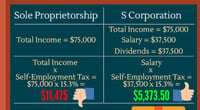
 novapixel |
 Dragon Lee |

 BOL SA RAM |
 US Home Buying Information Home Insurance |
 Sunny Mom |
  Pleasant K |
  Rolling Joy Life |
  lidus |
  French Macarons |
  Central Intelligence Agency Deputy Director |
  ATL Power 1 |
  MP Forever |
  Soy Angelino |
  San Jose Pop |
  Pronunciation Yo |
  hamooo |
  Entip |
  Yavrix 92 |
  cherry cherry |
  Coastal city |
  There Are Such Things in the World |
  Mazinger Z Rocket Punch |
  celtics |
  shinee cho |
  Kondae Garusong Blog |