
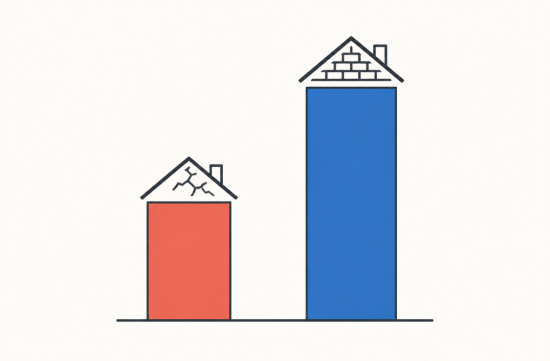
A while ago, a friend of mine was upset because they received much less money than expected from their insurance after their roof collapsed due to heavy snowfall.
When they got an estimate to replace the roof, it turned out the insurance payout was less than half of what was needed.
It turned out that the insurance company only paid out the amount after depreciation because the roof was old.
This is known as actual cash value, which deducts the amount used from the cost of rebuilding.
In contrast, replacement value covers the full cost of rebuilding with current materials and labor without depreciation.
So, depending on how you are insured, the amount you receive can vary significantly even for the same incident.
If replacing the roof costs $15,000, with actual cash value, you might only get around $9,000 after depreciation, leaving you to cover the remaining $6,000 out of pocket.
As of 2025, the average reconstruction cost for homes in the U.S. is about $280 per square foot.
For a typical-sized home, this means reconstruction could cost nearly $410,000, which surprised me when I saw that number.
The issue is that your current dwelling coverage may not keep up with this amount.
If you bought your home several years ago or have remodeled since then, there's a good chance there's a gap between the amount you insured for and the current reconstruction costs.
According to a study by the Coalition and the Consumer Federation of America, 60% of U.S. homes are at least 18% underinsured.
This means many people have left their insurance amounts unchanged while home values have risen each year.
There's also the 80% rule, which states that if you don't cover at least 80% of the reconstruction costs, the insurance company will reduce your payout by that percentage if you file a claim.
For example, if the reconstruction cost is $400,000 but you only insured for $300,000, you're barely meeting the 80% threshold, and if it's lower, you'll face penalties.
That's why more people are opting for extended replacement cost coverage these days.
This is an endorsement that typically adds 25% to your dwelling limit, and it only costs an additional $30 to $50 per year, so it's not a huge burden.
There's also guaranteed replacement cost, which has no limit, but not many insurance companies offer it, and it tends to be more expensive.
Similarly, there's an endorsement called inflation guard, which automatically increases your dwelling limit each year based on rising construction costs.
If you don't include any of these options, the amount you insured for when you first signed up could be far from current prices in a few years.
Additionally, personal belongings like furniture and appliances can also be chosen as either actual cash value or replacement cost, so you should consider that as well.
If you've made improvements to your home, like a new roof or kitchen, you need to update your insurance company to ensure the reconstruction costs are accurately reflected.
However, replacement value isn't a catch-all; for disasters like floods or earthquakes that are excluded from basic policies, having the right options won't help without separate insurance.
I would first check if my dwelling coverage amount aligns with current construction costs and likely choose to add an extended option.
Getting a reconstruction estimate from a local contractor is also a good way to gauge if your insurance is sufficient.
Make it a habit to ask your agent for a reconstruction cost reassessment each year during renewal; this is a great opportunity to do so.
Watching my friend's situation made me realize that cutting coverage to save a few dollars on premiums could lead to much bigger losses in the long run.


 Softy |
 Michigan Enthusiast |
 Anna Life |
 JESIKYEOALBA BLOG |
 Dad's Tribute TC |

 ovelion |


 Pronunciation Yo |
  hamooo |
  Entip |
  Yavrix 92 |
  cherry cherry |
  moonlight |
  Coastal city |
  There Are Such Things in the World |
  Mazinger Z Rocket Punch |
  celtics |
  shinee cho |
  Kondae Garusong Blog |
  quiet river |
  alamo |
  Lol Life |
  Waiting for Godot |
  parlon |
  Say Yes in English |
  Sayonara H |
  rigid |