
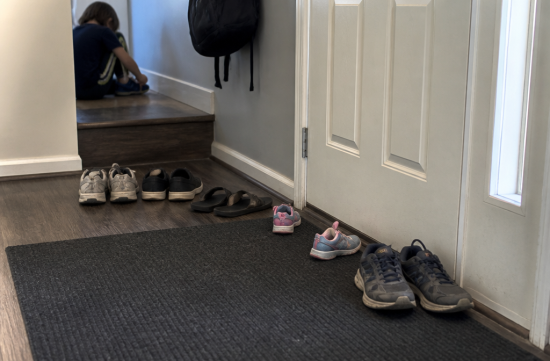
There's a question that Korean-American children growing up in the U.S. often ask at some point: "Why is our home different from others?"
From taking off shoes at the entrance, the smell of lunchbox side dishes, to being dragged to Korean school every Saturday morning, the evidence piles up for the child until it suddenly bursts forth.
After returning from a friend's birthday party, there's that look of surprise as they gaze at their own dinner table.
When that expression builds up over a few days, it turns into a question. A point of comparison is necessary for a question to arise.
Interestingly, this question comes up much earlier than parents expect.
Developmental psychology research shows that even a six-month-old baby categorizes people based on skin color. By the age of three, they start associating certain traits or characteristics with specific racial groups.
However, a study published in the 2020 Journal of Experimental Psychology: General found that when asked, American adults believed a child should be at least five years old to bring up such topics.
The researchers pointed out that adults significantly underestimate children's cognitive abilities. I felt a bit taken aback at this point.
The child has been quietly observing for years, while the adult remains stuck in the mindset of "they're too young to understand."
So, that question doesn't just pop up one day; it has been on the agenda for quite some time.
There's one important fact I want to add here.
According to an analysis by the Migration Policy Institute using 2024 census data, one in four children in the U.S., or 26 percent, has immigrant parents.
In the same analysis, it was found that 85 percent of children from immigrant families are born in the U.S.
In other words, that "our home is strange" actually means that statistically, it's quite a common household in the classroom.
Of course, if you tell a child about percentages, their eyes will glaze over in an instant. Numbers are best used to soothe adult minds.
Standing in a Korean market parking lot, you can feel that 26 percent is not just a number but a reality.
At this point, I think we can say that "homes like ours" are not exceptions but already a way of life.
The place where differences are most clearly revealed is undoubtedly the dining table.
According to data from the Pew Research Center, among Korean-Americans aged five and older, 59 percent speak Korean at home.
However, when it comes to English proficiency, 94 percent of U.S.-born Korean-Americans are fluent, while only 50 percent of immigrants are.
This means that even when sitting at the same table, each person may be comfortable in a different language. Differences are not just outside; they are already sitting inside the home.
It's not just a one-time question when they're young.
Research on identity shows that concerns about one's roots typically arise during adolescence, and it's not until early adulthood that they are somewhat resolved.
So, the question from a five-year-old is more like a trailer, while the main feature returns during middle and high school.
At that time, the form of the question changes a bit. Instead of "Why is it different?" it becomes closer to "Which side am I on?"
Fortunately, recent research trends indicate that children who embrace both cultures tend to cope better in terms of mental health.
This suggests that it's better to tell them they can have both rather than forcing them to choose one.
Perhaps that's why the answers adults typically give to that question tend to fall into three categories.
The first is to close the door with "It's just how it is." It's the quickest and easiest response, but the child's question mark remains.
The second is to rank with "We are better." This fosters pride but also nurtures a habit of comparison.
The third is simply explaining the facts. Who came from where, what habits remain in this house, and how it has come to be this way.
I believe the third option is the best. There are times when a child is looking for an explanation rather than comfort.
Receiving differences as a statement of deficiency somehow feels like an excuse, while receiving them as a list of information feels informative.
Honestly, there are days when I find explanations tedious too. On those days, I want to say, "I'll tell you later" and sneak away.
In fact, I often see people who are afraid of this question. They get anxious about giving the wrong answer and hurting the child.
However, the fact that the question has been asked means there's still a willingness to ask me.
The truly scary thing is when the child has figured everything out and becomes quiet; it's not when they are asking loudly.
So, when that question arises, I choose to feel a bit glad.
Even if I stumble like a panda and fall, it's much better to keep talking it out until the end, don't you think?





 lavender |
 logger |
 Conflite Teacher |
 Unknown Dog Walk blog |
 Khan Film Blog Production |
 sugartrail |
 vanillastorm |
 bloom |

 quiet river |
  shinee cho |
  alamo |
  Lol Life |
  Waiting for Godot |
  parlon |
  Say Yes in English |
  Sayonara H |
  rigid |
  Ohio Ohayoung Hello |
  U.S. Military Recruitment Information |
  You Turn Me On |
  DaeBak Electronics CNET |
  Anjollinya Blog |
  solid90 |
  elion |
  xylora |
  Study Abroad Life Know-How Tips |
  cheesepup |
  carpflow |