
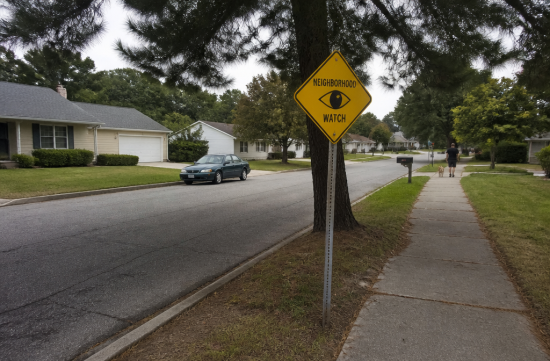
Many neighborhoods have a yellow sign at the corner that catches your eye while walking. The sign that reads "Neighborhood Watch Area" made me think at first that there might be surveillance cameras installed.
It turns out that this is neither a camera nor a security guard, but a sign indicating a voluntary crime prevention group where neighbors look out for each other. As the name suggests, it means neighbors are watching each other.
These signs can be found in neighborhoods with large mansions as well as in ordinary alleys. Given their prevalence regardless of home prices or neighborhood size, it seems to be quite a common culture.
This system has been around for over half a century. It began in 1972 with a nationwide program created by the National Sheriffs' Association.
In the late 1960s, as crime rates increased, residents began to take action to watch over each other's homes and alleys, which eventually became an official program.
In 2002, the program's name changed when the U.S. Department of Justice and citizen volunteer groups got involved, and it is now called the National Neighborhood Watch. Since then, its role has expanded beyond crime prevention to include disaster preparedness and emergency response.
Currently, there are about 20,000 neighborhood watch organizations managed by the National Sheriffs' Association across the country, indicating that this is not a small cultural phenomenon.
However, one can't help but wonder if this really reduces crime. Research shows some interesting statistics.
A systematic meta-analysis found that in areas with neighborhood watch activities, crime rates decreased by 16% to 26%. Out of eighteen evaluations analyzed, fifteen showed a reduction effect.
However, the effectiveness was not uniform across all areas. Looking at individual programs, only about half showed significant effects, while the rest had ambiguous results.
Criminologists generally explain this effect in three ways: increased reporting by neighbors leads to more information reaching the police, unusual movements become more noticeable, reducing opportunities for crime, and stronger bonds between neighbors create natural social control.
Even without cameras or security guards, the mere perception that someone is watching can reduce opportunities for crime, making it a more rational approach than one might think.
However, this system also has its shadows. The Trayvon Martin case in Florida in 2012 starkly illustrated this.
In that incident, a neighborhood watch volunteer pursued and fatally shot an unarmed Black teenager, believing him to be suspicious. This incident sparked a nationwide debate on racial profiling.
In fact, the volunteer's actions contradicted the guidelines recommended by the National Sheriffs' Association. The principles state not to arm oneself, not to go alone, and to observe and report rather than confront, all of which were violated.
Following the incident, the local city enacted regulations prohibiting volunteers from carrying firearms and pursuing suspects. This case shows how significant the gap can be between the intent of the program and its actual operation.
At this point, I believe that the way neighborhood watch is operated is much more important than the program itself.
If there is no training or oversight regarding who is watching and what criteria are used to determine suspicion, a program that starts with good intentions can easily become a tool for bias against certain groups.
Therefore, I think neighborhood watch is much more stable when it operates under a structure where local police and city governments clearly provide education and guidelines, rather than relying solely on the goodwill of individual volunteers. Ultimately, the key is not just that neighbors care for each other, but that this concern operates fairly and without bias.
Personally, I believe that neighborhoods where neighbors know each other's names are much safer than those with cameras or security guards. However, I think that at least minimal standards and training are essential to ensure that this concern does not turn into surveillance.
 vibetowntraveler1989
 SaladBase






 Giant Squid and Sweet Potato Soup |
 Lol Life |
 lavender |
 logger |
 Conflite Teacher |
 Good Karma |

 Choco Choco Star |
 Yahoo LALA |
  cheesecake07 |
  My Miami Stories |
  windylotus |
  Mia Flori |
  velaro29 |
  velaro |
  foxtrot83 |
  moname |
  mapleline |
  US Legal Consultation on Trials |
  UNI Lover |
  Karina's Blog |
  California Dreamer |
  Choco Mint Creator |
  Chili Boy Club |
  NE Hodori Preik |
  torvik |
  charger |
  holy cheese |