
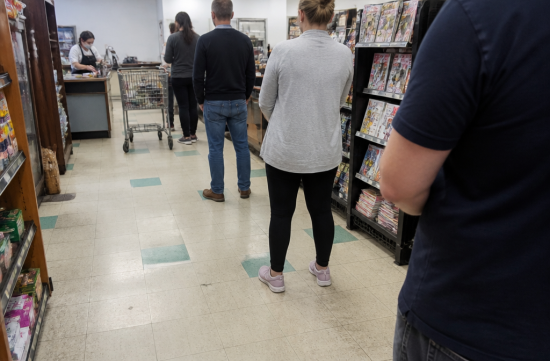
There was a time when I stood in line at a local coffee shop, and the person in front of me was standing far enough away that I was confused about whether they were in line or just standing there.
When I cautiously moved closer, the person in front shifted slightly forward. It was a signal to keep my distance.
In Korean supermarkets, even if the front of my cart is almost touching the heel of the person in front, no one says anything. I've always wondered where that difference comes from.
Think of the yellow line drawn on the floor in front of a bank teller or the waiting line at an airport security checkpoint.
Those lines are actually drawn on the floor to reflect the distance that people were already maintaining.
This step back has a name. It's called proxemics, a concept defined by anthropologist Edward Hall in the 1960s.
Hall divided the distances people use based on their relationships into four zones. Within 18 inches, or about 45 centimeters, is the intimate distance; 1.5 to 4 feet is personal distance; and beyond that is social distance.
That step back in line is ultimately an action to maintain personal space.
There are studies that show just how different this is across cultures. A 2017 study published in the journal Cross-Cultural Psychology surveyed 42 countries with 8,943 participants.
On average, people felt comfortable standing 135.1 centimeters away from strangers, 91.7 centimeters from acquaintances, and 31.9 centimeters from close friends.
The country that kept the farthest distance from strangers was Romania, at around 140 centimeters, while Argentina was the closest, at about 80 centimeters.
It surprised me that there's a 60-centimeter difference among humans depending on the country.
The only environmental variable that had significance was temperature. Countries with higher average temperatures tended to stand closer to strangers.
Conversely, they preferred to keep more distance from close friends. In hotter climates, it seems acceptable to be close to strangers but not to family, which made me chuckle as I read.
There were also differences based on gender and age. Women preferred to keep a greater distance from strangers, and older individuals wanted more space even from acquaintances and close friends.
However, this sense of distance isn't solely a result of etiquette training. Evidence suggests that there are specific areas in the brain responsible for this.
A well-known study by a Caltech research team published in Nature Neuroscience in 2009 found that patients with damage to both amygdalae felt no discomfort even at a distance of 34 centimeters from the experimenter.
In the same situation, healthy participants reported feeling comfortable at about double that distance. When someone got too close, the amygdala in healthy individuals reacted.
So, the discomfort felt when someone is too close in line isn't just due to a sensitive personality; it's a warning signal being triggered.
However, I believe the real core of American lines is the order rather than the distance. This was confirmed by a study conducted by Stanley Milgram's research team in 1986, which involved actually cutting in line at 129 different locations.
In cases where someone cut in line, 21.7 percent of people protested verbally, while 14.7 percent expressed their discontent through eye contact or gestures. Physical contact, such as pulling or pushing, resulted in a 10.1 percent protest rate.
The variation depended on the conditions. If one person cut in, 54 percent of the line protested, but if two people cut in together, the protest rate soared to 91.3 percent.
Conversely, if two people were already positioned behind the person cutting in, the protest rate dropped to 5 percent. This indicates that protests are not just about a sense of justice but also about perceived loss.
In fact, 18.2 percent of those in the four spots behind the person who cut in protested, while only 8 percent of those in the two spots in front reacted.
Putting these numbers together paints a clear picture. Stepping back isn't indifference; it's a kind of contract.
I won't get close enough to touch you, and in return, you won't skip my turn.
The principle of first come, first served is a rule that has been refined in this country for quite some time, and because that rule holds, there's no need to crowd together to secure a spot.
Lines are one of the few systems that function without anyone monitoring them. They are maintained not because of police oversight, but because the people standing behind act as their own watchmen.
To fulfill that watchman role, a certain amount of space is needed to avoid conflict. Being too close can easily lead to disputes rather than vigilance.
When I first immigrated, this seemed cold to me. Now, I see it differently.
If you don't know where the end of the line is, instead of standing close and trying to gauge, you can just ask the last person. Most will smile and let you know.
On the other hand, the habit of standing too close can easily be interpreted as impatience here. What you might think is just holding your place can be perceived as pressure by others, so there's no need to create unnecessary misunderstandings.
I appreciate that step back. That seemingly empty space actually supports order.


 lavender |
 logger |
 Conflite Teacher |
 Unknown Dog Walk blog |
 Khan Film Blog Production |
 solvix18 |

 Coding Elf |
 action blog 101 |
 Hajiwon Blog Hair Salon |
 alamo |
  Lol Life |
  Waiting for Godot |
  parlon |
  Say Yes in English |
  Sayonara H |
  rigid |
  Ohio Ohayoung Hello |
  U.S. Military Recruitment Information |
  You Turn Me On |
  DaeBak Electronics CNET |
  Anjollinya Blog |
  solid90 |
  elion |
  xylora |
  Study Abroad Life Know-How Tips |
  cheesepup |
  carpflow |
  mapsina |
  Softy |