

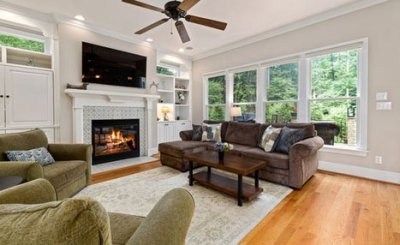
There is a couple who has lived in Rancho Cucamonga since the early 2000s and raised three children.
When they first moved in, they appreciated the larger size and multiple rooms compared to their home in LA.
However, as time passed and their youngest joined the U.S. Air Force and became independent, the house suddenly felt too big.
Two of the rooms are almost empty, and they no longer use the yard as they once did. That said, just leaving the house alone doesn't mean it doesn't require maintenance.
In the summer, they need to run the air conditioning, take care of the yard, and there are repairs needed in their older home.
So, the couple started thinking about downsizing.
"Would it be more convenient to sell this house and move to a smaller condo?" However, after visiting some listings, they realized there were quite a few factors to consider.
The first thing they compared was the electricity bill.
Rancho Cucamonga gets quite hot in the summer. Especially in July and August, they have to use the air conditioning continuously, and a large single-family home has a lot of space that needs cooling.
Having two unused rooms doesn't mean they can just avoid cooling those areas in the summer.
In 2026, the electricity rates in this area are about 32 to 34 cents per kilowatt-hour, and the average monthly electricity bill per household is around $329.
In the summer, electricity bills can be 30 to 50% higher than usual.
So, with just the two of them living there, it raises the question of whether it's really necessary to keep cooling the entire large house.
The second factor is the home price.
Single-family homes in Rancho Cucamonga often sell for around $770,000 to $850,000, while condos can be found for about $420,000 to $520,000.
Selling a large house and moving to a smaller condo could leave them with a significant amount of cash.
Of course, condos come with HOA fees.
They may have to pay a few hundred dollars each month, which might initially lead to the thought, "Why do I have to pay more for my own home?"
However, that money often covers the shared facilities and external maintenance of the complex.
Compared to managing the lawn, trees, and the exterior or roof of a single-family home, the situation is a bit different.
They also need to compare insurance. For a single-family home, they typically get insurance for the entire house, but for a condo, the HOA may cover the building's exterior and common areas with a group insurance policy.
However, they must check what the HOA of the condo they are considering is responsible for. This has been in the news a lot lately.
And a very important factor is property taxes.
If they have lived in a home in California for a long time, the property tax they are currently paying may be lower than expected.
Just because home prices have risen significantly doesn't mean property taxes increase every year to match current market values.
So, when selling a long-time home and buying a new one, they need to calculate how much the property tax will change.
Especially if they are over 55, they should also be aware of Proposition 19.
If certain conditions are met, they can transfer the property tax assessment from their existing home to a new home within California, and this can be used up to three times.
This is a significant consideration for those looking to downsize before retirement.
If they visit a condo, they shouldn't decide just because the interior looks nice. They also need to check if the HOA has enough funds saved up.
If major repairs like roofing or exterior work are needed and the HOA lacks the funds, homeowners could face special assessments one day.
On the other hand, if they plan to continue living in their current single-family home, they should also consider how many more years the roof, air conditioning, and heating systems can last.
Ultimately, now that all three children have left, they need to first consider whether having two empty rooms and a large yard is really necessary.
If they have guests frequently or plan to use the rooms as hobby spaces, maintaining a large home can still make sense.
However, if the rooms remain empty and they spend several hours each week maintaining the yard while running air conditioning throughout the large house every summer, that changes the situation.
Owning a large home and needing a large home are two entirely different issues.
By calculating heating and cooling costs, HOA fees, insurance premiums, and property taxes one by one, they might find that the answer to the final question comes surprisingly easily.
"Do we need the space of this house for the next ten years, or will we just be spending time managing this house?"
Downsizing is not just about moving to a smaller home. It can also be a choice that makes future living a bit lighter.
 NightQueen
 JakyungSis







 Tesla X |
 Another Eden Channel BLOG |
 Victory 1988 |
 Smile Face |
 Helpful Life Stories |
 Choi Cho |
 CA Real Estate |
 Star Way |
 Lifestyle Information Search USA |
 horse |
  moodansa 77 |
  zymit |
  maplefox |
  Fun Flex Life |
  hopeful |
  Reeno |
  Coastal city |
  meonetoo |
  Winter bear |
  Peach Jam Eating Laughter |
  Nando Raldo |
  American Man in a Mask |
  wendra |
  silver |
  bada2002 |
  horizon |
  Nanana Nanana Nanana |
  victoria jung |
  Kkikki Ppappa Shout Out Loud |