

I have lived in Las Vegas for over 10 years now.
When I first arrived, the most surprising thing was this: Why is so much water being used in a desert?
In the summer, temperatures easily exceed 110 degrees, yet fountains dance to music in front of hotels, golf course grass is greener than rice paddies in Korea, and most single-family homes have a swimming pool.
At first, I thought there must be some water deity living underground in Las Vegas.
But as time went on, I realized that a significant portion of that water comes from Lake Mead.
Lake Mead is not just a lake where tourists stop to take a picture after visiting Hoover Dam.
It is a massive reservoir directly linked to the water and power issues in the western United States, including Las Vegas.
So when the news mentions "Lake Mead water level," people living here perk up their ears.
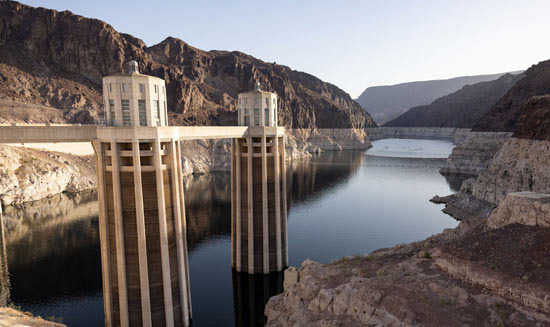
A few years ago, when the water level dropped to around 1,040 feet, it was truly strange to see when visiting Hoover Dam. A white band appeared on the mountainside. That was where the water used to be.
To put it simply, it's like draining a bathtub and leaving only the stains on the walls. The only difference is that it's a much larger bathtub.
As the water recedes, all sorts of things have emerged. Old sunken boats, various objects, and even human remains have been found.
True to Las Vegas, there were even rumors that these remains belonged to someone dealt with by the mafia long ago.
While the lake is losing water, people are still filming CSI Las Vegas.
However, the real issue is no laughing matter. The water in Lake Mead ultimately comes from the Colorado River.
Snow that accumulates in the Rocky Mountains during winter needs to melt in spring, but prolonged drought and high temperatures have complicated the situation.
If there is less snow or if the melted water evaporates and is absorbed by the soil, the water reaching Lake Mead decreases.
Moreover, the water allocation agreement is a relic from over 100 years ago.
When the Colorado River Compact was created in 1922, many argue that the amount of water that could be supplied from the river was estimated quite optimistically by today's standards.
In the meantime, the population in the western regions, including California, Arizona, and Nevada, has skyrocketed. It's no wonder that a century-old calculation is causing friction in the 21st century.
Interestingly, while it seems that the hotel fountains in Las Vegas are the main culprits, the reality is that agriculture is the largest consumer of water in the Colorado River basin.
In a situation where water-intensive crops are grown on a large scale, being told to finish my shower three minutes earlier feels a bit unfair.
I doubt that finishing my shower three minutes early will fill Lake Mead.
That said, Las Vegas is not sitting idle either. The city is very serious about water recycling.
They have been processing water used indoors to return it to the system and have long been promoting policies to eliminate unnecessary lawns.
The real concern arises when the water level drops drastically. It affects the power generation at Hoover Dam, and if it gets worse, it complicates the issue of sending water downstream.
After living in Las Vegas for 10 years, worrying about home prices, property taxes, and electricity bills, I now find myself checking how much water is in the lake.
Ultimately, Lake Mead is not a tourist attraction in Las Vegas. It is a massive water tank connected to our home faucet.
 CoffeeQueen
 UrbanStar95
 mooncitywalker2017







 washington mom |
 California Dreamer |

 Investment Campus Home Ownership |
 U.S. Retirement Pension Information |
 US Legal Consultation on Trials |
 korvix |
 vegas mom |

 Lego My Ego |
  Springs Korea |
  nixon |
  mini hometown |
  Gleeee |
  MacMorningBlog |
  ASURA |
  Elastico |
  shaket |
  vionoo |
  chocolate |
  Whisper |
  Star Voyager |
  InDiGo |
  Rocky Mountains |
  Whoever It Is, I Don't Know |
  Why Not Me |
  Plastic Rose |
  Rice Shop Uncle BLOG |
  Victory 1988 |
  Gook Rule |