

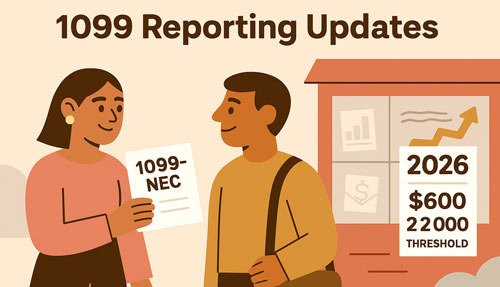
For those who have been in business in the U.S. for a long time, the $600 expense threshold is a well-known standard for expense reporting.
When I was running a business in LA and paid contractors, I would naturally think, "I need to send a 1099 if it exceeds $600" once the payments went over that amount.
This system has been a long-standing standard, almost common knowledge for those doing business in the U.S.
However, starting in 2026, this long-standing practice is set to change significantly. According to official guidance from the IRS, the reporting threshold for certain 1099 forms, which was $600 until 2025, will increase to $2,000 for payments made in 2026.
The most notable forms affected are Form 1099-NEC and Form 1099-MISC.
For example, if I paid a freelancer $1,000 for advertising flyers in 2025, I would have been required to issue a 1099-NEC since it exceeded the $600 threshold under the old rules.
However, if I paid the same freelancer $1,000 in 2026, it would not meet the new $2,000 threshold, and I would not have an obligation to report it.
This is a significant change for small business owners who previously had to collect W-9 forms and issue 1099s every year for payments around $700 to $1,200.
Even more surprising is the scale of this change. According to data from the U.S. Treasury and IRS, it is estimated that there were about 18.8 million 1099-NEC forms filed for amounts between $600 and $2,000 in 2024.
Similarly, there were about 7.9 million 1099-MISC forms in the same amount range. This means that changing just one number from $600 to $2,000 could affect tens of millions of reporting cases each year.
One might wonder why this change is happening now. The $600 threshold was established in a time when inflation was much lower than it is today, and it has remained essentially fixed since then.
According to IRS data released in 2026, the $600 reporting threshold has been in place since 1954. For 71 years, the figure of $600 has remained unchanged. The purchasing power of $600 in 1954 is vastly different from that of $600 in 2026, yet the standard was not adjusted for over 70 years.
In fact, as time has passed, a $600 payment to a contractor is no longer considered a significant transaction. It can easily be exceeded with just one photo shoot or a few graphic design jobs in LA.
There is a very important point to note here. "Not receiving a 1099 means you don't have to pay taxes" is absolutely not the case.
A 1099 is not a document that generates income; it is an informational reporting document that notifies the IRS of payments made.
If a freelancer earns $1,800 in 2026 and does not receive a 1099-NEC, that $1,800 does not automatically disappear from taxable income. The obligation to report income and the obligation for the payer to issue a 1099 are separate issues.
Also, not all 1099s will uniformly change to the $2,000 threshold.
There are separate criteria and exceptions based on the type of payment, and if backup withholding applies, there may still be a requirement to report regardless of the amount. The IRS has specified this separately.
Interestingly, the new $2,000 threshold will not be set in stone for decades like the previous $600 threshold.
According to IRS data, starting in 2027, the threshold will be adjusted based on inflation rates.
Personally, I see this as a quite realistic change. For those running a small business or being self-employed in the U.S., while taxes are a burden, the amount of paperwork can be overwhelming.
We are moving from an era where every small contract was tracked due to the outdated $600 threshold to a more realistic $2,000 standard.
However, business owners should not think, "Since it's under $2,000, I don't need to keep any records."
Payment records and expense documentation still need to be maintained, and the other party's obligation to report taxes does not disappear.
The change is not in the tax itself but in the criteria for when a business must report to the IRS with a 1099 for transactions below a certain amount.
For decades, U.S. business owners have had the formula "over $600 means a 1099" ingrained in their minds. Starting in 2026, it seems we will need to remember it as "$2,000."
It may seem like just a small number has changed, but the administrative burden felt in actual business operations will be a significant shift.
 CliffDiabeto
 AutumnMonica
 MACCIOOTON







 Investment Beginner Company Information Encyclopedia |
 Always Dreaming of Big Success |
 happy 9 |
 coloradoman |
 pintos |
 Study Abroad Life Know-How Tips |

 Anjollinya Blog |
 Sunny's Travel in America |
  shadow 007 |
  sun walker |
  Choco Choco Star |
  midnight blue |
  honeypot |
  summer |
  adventure77 |
  flexible |
  Shintongbangtong Shin Naerin James Park |
  truepixel |
  Kathy's Blog |
  Hae Naem |
  quatspace |
  Marisol |
  Glassroom |
  Granola |
  joyfull yang |
  Olivia's Blog |
  Living in America and Writing Essays |
  Piano Teacher Blog |