
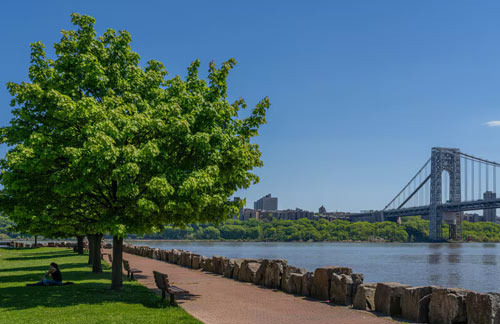
Weather is a topic that comes up no matter where you live. If you're visiting Palisades Park for the first time, it's natural to wonder what the weather in New Jersey is like.
Many people think, "It's near New York, so it must be similar to New York," which isn't entirely wrong.
However, looking at specific figures reveals quite distinct differences by season, and knowing these differences can be practically helpful for daily life.
I've always been curious about how it compares to the climate in Korea.
In terms of annual temperature range, Palisades Park experiences temperatures between 26°F (-3°C) and 85°F (about 29°C) throughout the year. The hottest month is July, with daytime highs reaching 83.8°F (about 29°C) and nighttime lows rarely dropping below 69.3°F (about 21°C).
Due to high humidity, the perceived temperature often feels higher. The coldest month is January, with daytime highs around 36.3°F (about 2°C) and nighttime lows around 25.7°F (about -4°C).
Compared to winter in Seoul, it's not extremely cold, but there are many humid and windy days, making it feel quite chilly. It might take some adjustment since the sensation is different from living in Korea.
Precipitation and snowfall are also important living information. Palisades Park receives about 50 inches (about 1,270mm) of annual rainfall, which is somewhat higher than the U.S. average. The month with the most rain is July, and precipitation is fairly evenly distributed throughout the year.
Unlike the concentrated rainy season in Korea's summer, rain falls consistently throughout the four seasons, reducing concerns about sudden droughts.
Snowfall averages about 30 inches (about 76cm) annually, with snow occurring from January to March, and in November and December. February sees the most snow, averaging 9.9 inches (about 25cm). This is a time when snow removal preparations and careful driving are necessary.
To summarize by season: Spring (March to May) sees gradually rising temperatures and blooming flowers, making it a great time for walks. Summer (June to August) is hot and humid, making it hard to get by without air conditioning. Fall (September to November) features beautiful foliage and cool weather, perfect for outdoor activities.
Winter (December to February) brings snow and days when temperatures drop below freezing, so winter preparations are essential. Overall, the four seasons are distinct, and the fall foliage season, especially, beautifully complements the scenery of the Palisades cliffs, which I consider one of the advantages of living in this area.
 BlueOcean
 HeartStory



 yentra |
 Cali M Law Group |
 quanta7 |
 Helpful Life Stories |
 wendra |
 Margarine Daebimama |
 squidogame |
 Google Idea |
 eatontown blog |
 Miju Communication News Blog |
  draxen |
  gallery |
  milkyotter |
  Zoom Zoom Zoom |
  noraro |
  tervox95 |
  vale vale |
  Golden life |
  andrew park |
  Peter Pan Pet |
  Balan |
  neroyo |
  Dreams Come True as Desired |
  Khan Film Blog Production |
  coloradoman |
  Living Economy Information Blog |
  rustley |