
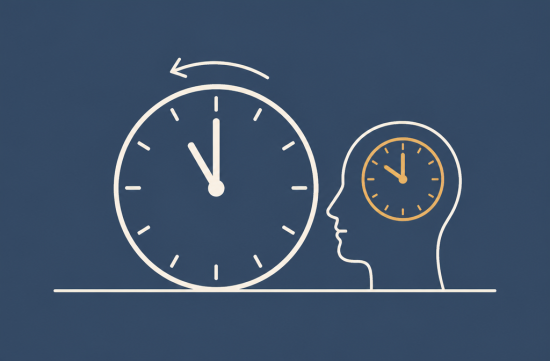
This Sunday, at 2 AM on November 1, the clocks will turn back to 1 AM. It's the end of Daylight Saving Time.
Your phone or computer will adjust automatically, but you'll need to manually change the clocks on your microwave, oven, and car dashboard. It's easier to do it all at once before bed on Saturday night.
Everyone is happy to gain an extra hour for free. However, every year around this time, the reactions I see from people seem a bit strange.
Those who claim to have slept an extra hour often look the most dazed on Monday. I'm no exception.
Of course, logically, if you sleep an extra hour, you should feel refreshed. That's how it works on paper.
But the body isn't a calculator. The key issue isn't the amount of sleep but rather the disruption of our biological clock, or circadian rhythm.
Our body's clock isn't set by a wall clock; it adjusts based on light. The American Academy of Sleep Medicine (AASM) explains that the cycles of natural light and darkness are the strongest signals for regulating our internal clock.
However, in just one day, the wall clock moves back an hour, while our bodies continue to produce melatonin according to last week's light schedule. It's like experiencing a one-hour jet lag without ever having flown. It's a smaller version of the dazed feeling you get after returning from Seoul.
Sleep experts from Harvard also point out that when local time and biological rhythms are out of sync, people feel sleepier during the day and have trouble falling asleep at night. This means that feeling tired isn't just in your head.
Academically, this is referred to as a mismatch between social time and biological time. In everyday language, it simply means your body is still living in last week.
The actual pattern looks like this: your body still thinks it's the old time, waking up around 5 AM by the new clock.
And by 9 PM, your body thinks it's 10 PM and starts to feel sleepy. As a result, you end up waking up early and feeling sleepy early for several days.
On top of this, there's the issue of the sun setting earlier. Looking at the sunset schedule near Southern California, the sunset on November 1 is at exactly 5 PM.
As it suddenly gets dark on your way home, your body mistakenly thinks the day is over, and then you spend several hours under fluorescent lights in that state. This can subtly wear you out. You also need to be more cautious of pedestrians during evening hours while driving.
Ironically, there's the use of that extra hour. Many people end up staying up late on Saturday night, thinking they have an extra hour to spare.
But then, they've already used up that bonus that night. This is why experts advise against using that extra hour to stay up late.
Especially for morning people, this can be tougher. Someone who usually wakes up at 6 AM will wake up at 5 AM by the new clock and start their day without being able to fall back asleep.
Fortunately, the fall transition is easier than spring. Since the morning light increases, it's generally easier for the body to adjust.
Typically, it takes a few days to adapt, but for some, it can take over a week. So, you just need to get through the first week.
So what should you do? First, get sunlight as soon as you wake up. Just standing by a window is fine, but walking outside for 10 minutes is the best option.
Second, dim the lights in the evening and put down screens at least an hour before bed. Bright artificial lighting can push your biological clock back again.
Third, many experts recommend cutting off caffeine after 2 or 3 PM. An afternoon coffee can last longer than you think.
Fourth, there's also the method of gradually shifting your schedule. A few days before the transition, you can push your bedtime and wake-up time back by 15 minutes each day.
Avoid sleeping in too much on the weekends. If your wake-up time is inconsistent, your biological clock won't be able to find a reference point, prolonging the adjustment period.
Honestly, among these four tips, the easiest and most effective is getting morning sunlight. It costs nothing, requires no apps, and you just need to stand outside with your coffee for 5 minutes before work.
If you still can't sleep after a few days or feel excessively sleepy during the day, then it's not just the clock's fault. If you're considering sleep aids or melatonin supplements, don't make decisions alone; consult a doctor or pharmacist.
This leads to the question of why we do this every year. In California, Proposition 7 passed in 2018, yet the clocks remain unchanged.
Proposition 7 didn't directly change the time. It merely opened the door for the state legislature to change it with a two-thirds vote within the limits allowed by federal law.
Year-round Daylight Saving Time requires federal congressional approval, and the Sunshine Protection Act that has been proposed has not yet passed. So, the clocks will turn back again this year.
Interestingly, the sleep medicine community has a stance on this. The AASM supports year-round standard time rather than fixed Daylight Saving Time, arguing that standard time aligns better with our body's clock.
Politicians want evening sunlight, while sleep scientists prefer morning sunlight. In this case, I'll side with the sleep scientists.
Anyway, this Sunday is coming. Go to bed at your usual time on Saturday night, and open your curtains first thing Sunday morning. Make sure to take advantage of that extra hour this time.
 SilverStone71
 CurryBotJump






 The Emperor Must Grow |

 squidogame |

 daddyyo |

 Top Beaches |

 Solo Yolo |

 Nanana Nanana Nanana |


 United States National Administrative Organization Stories |


 cathywhite |

 ssome |
 skykong |
 Shining Our Own World |
 gardener 007 |
 golfmaster |
 Who's watching? |
 endone |
 RockStar |
 Casa Mia |
 You Only Live Once |
 Hardworking CPA |
 Joyce 77 |
 Runner Kim |
 My Town My Way Blog |
 My Miami Stories |
 Entip |
 Tony Park |
 DJ DC BLOG |