

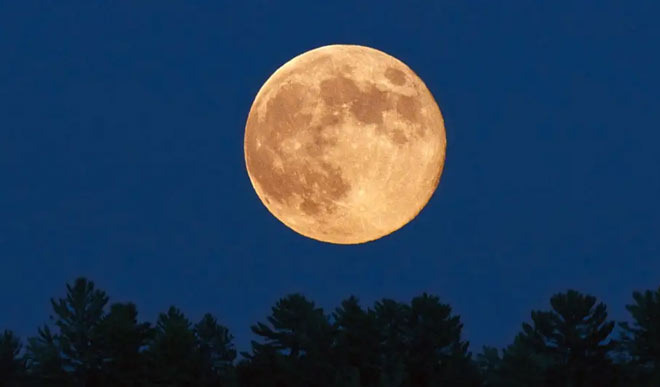
In early November, the moon will feel unusually large and bright. It is said to appear 14% larger and about 30% brighter than usual.
The reason is that this is the time when the brightest full moon, known as the 'Beaver Moon', rises among the supermoons.
In the United States, the moon can appear red and large, and it has various names depending on the time. The phenomenon commonly referred to as a supermoon occurs when the full moon nearly coincides with the point at which the moon is closest to Earth (perigee), making the moon appear extraordinarily large and capturing the attention of many.
The name 'Beaver Moon' originates from the traditions of Native Americans and early settlers. November was the time when beavers completed their dams and finished molting before winter. It was also the time when hunters set beaver traps to obtain fur. Thus, the full moon during this period was called the 'Beaver Moon', and the name has continued to this day.
This November's supermoon is not just a large and bright moon; it is also the closest perigee full moon of the year 2025. This means that the distance between the Earth and the moon decreases to about 356,000 kilometers, coinciding with the full moon, making it appear particularly large.
As the moon gets closer to Earth, the gravitational effect causes a slight rise in sea levels, known as the 'supermoon tidal effect', and in some coastal areas, the difference between high and low tides can be more pronounced. However, in most areas, people will simply experience a special night under a brighter moonlight than usual.
The best time to see the supermoon in the night sky is just after sunset and around dawn. At this time, the moon rises close to the horizon, creating a 'moon illusion' that makes it feel even larger. The actual size does not change, but it is perceived as such when compared to surrounding buildings or mountains. Therefore, in the city, when the moon rises above tall buildings, or in the countryside, when it rises between trees, it feels majestic, like a scene from a movie.
This Beaver Moon shines even more brightly in the cold air of late autumn. The air is clear and the humidity is low, preventing the moonlight from becoming hazy. So, on a cloudless night, one can see the 'seas of the moon (Mare)' and shadows on the moon's surface clearly with the naked eye. If you have a telescope or binoculars, you can even observe the outlines of craters distinctly.
The moon during this period holds significance beyond just an astronomical phenomenon. Throughout history, people have regarded the full moon as a symbol of abundance, completion, and gratitude. In particular, the full moon in November coincides with the time of finishing the year's harvest and preparing for winter, earning it the title of the month of 'organization and recovery'. Thus, while gazing at the Beaver Moon, people often reflect on the past year and prepare to start anew.
In today's busy world filled with artificial lights, looking at the moon in the sky is a moment to pause and feel the rhythm of nature. The moonlight is always calm yet possesses a strong presence. It is light that is much older than streetlights and the only light that humans have gazed upon since before civilization. This November, when you look up at the sky, the unusually large moon seems to tell the stories of all those years.
Take a warm cup of tea and step outside for a moment. If you look at the sky while avoiding the city lights, a large moon will slowly rise between the clouds. It is not just a simple moon, but a moment of tranquility given to us at the boundary of the seasons, a greeting from nature. This year's brightest supermoon, the Beaver Moon in November, is a comfort in itself.







 Nanana Nanana Nanana |
 West Kong |
 Information on All Regions of the United States |
 United States National Administrative Organization Stories |
 cathywhite |
  Tonky |
  viroma |
  cookie |
  Live and that's it |
  Alright Twain |
  eatontown blog |
  HAWAII Korean Church News |
  Amore |
  linex |
  Balancework |
  laro90 |
  MEDBIO American Doctor Blog |
  SWAT TEAM BLK |
  DREAM BIG |
  frostbite |
  330 Forever My Love |
  El Dorado |
  dralix58 |
  Gorama Round |
  Skydiving |