
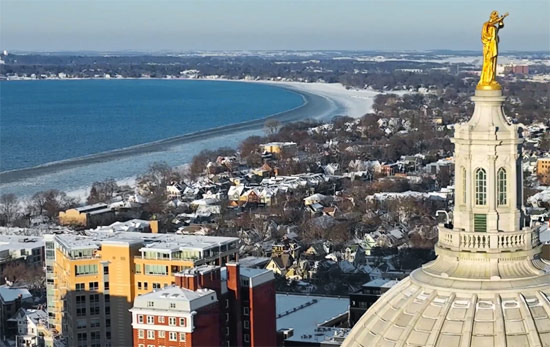
When choosing a city to live in after immigrating, online searches often highlight only the positive aspects.
They mention good school districts, beautiful nature, safety, and overall livability. However, for those who actually have to pack up and move and live there for years, the downsides are equally important. Madison is no exception.
First and foremost, Madison's biggest advantage is its stability. As the capital of Wisconsin, there are many state government jobs, and it is home to the large University of Wisconsin-Madison. With a university hospital and medical facilities, the city is not one that suddenly falters when the economy takes a slight downturn. This makes it a fairly decent city for immigrants, especially those with jobs related to education, research, healthcare, and public institutions.
For families with children, the educational environment is also crucial. Since UW-Madison is located right in the middle of the city, it's not just the university that is good; the entire city benefits from libraries, museums, research facilities, and various cultural events. However, one should not assume that "all schools in Madison are good." In the U.S., even within the same city, there can be significant differences between schools and districts, so it's essential to check school ratings when looking for a home.
The living environment is relatively calm as well. Unlike cities like LA or Chicago, which are crowded with people and cars, commuting stress is lower, and nature is close by. It's nice to walk or bike around the lakes.
However, there are definitely downsides from an immigrant's perspective.
The first is winter. If you come from California or the South, you might wonder, "Why did I come here?" during your first winter.
The sub-zero temperatures can last for a long time, and extreme cold can drop below 0 degrees Fahrenheit. Shoveling snow is a chore, and clearing snow off your car is another task. It's really annoying when you need to leave for work in the morning and find your car windows frozen solid.
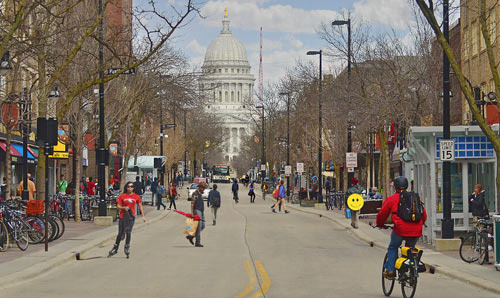
The second downside is the Korean community infrastructure. There are some Koreans, particularly students, professors, and researchers around UW-Madison, but it's not comparable to areas like LA or the suburbs of Chicago. Living where you can have "sul lung tang today, jjajangmyeon tomorrow, and Korean sushi on the weekend" is limited here. You can find Korean groceries, but the variety is not the same as in larger Korean markets.
Housing prices can no longer be considered cheap. The median home price in Madison has risen to around $400,000, and in good school districts or popular areas, it can quickly exceed $500,000 to $600,000. Upscale neighborhoods like Shorewood Hills or Maple Bluff often have homes that exceed $1 million. If you come with the assumption that "housing will be cheap in the Midwest," you might be surprised.
The racial diversity may also feel lacking compared to larger cities. While the area around the university has a significant international presence, the overall city has a higher proportion of white residents. If you've lived in areas with a large Korean population, you might initially feel like you stand out.
Public transportation is improving, but for immigrant families, having a car is much more convenient. Especially considering winter, the areas and activities you can access without a car are limited.
Still, I don't think Madison can be strictly evaluated as good or bad. If you're looking for a vibrant Korean town and warm winters, it might not be the right fit. Conversely, if you value education for your children, stable employment, a natural environment, and a quiet lifestyle, it can be quite attractive.
Living as an immigrant ultimately involves choices about what you give up and what you gain.
Madison is a city that reveals its advantages gradually rather than one that you fall in love with at first sight.
 SpringPlus
 NutcrackDoll
 MoonCafeBoy





 cheesepup |
 breezem |
 yentra |
 virex |
 vexon87 |
 winter |
 marketbox |
 My Love Bambino Alaview |
  Wenda |
 coloradoman |
  lumora |
  Valley Bang |
  pravix22 |
  Cohesive Kong |
  werehere |
  problemo |
  galaxy88 |
  breezelove |
  hazelnut |
  Korean News American Blog |
  AH LALA |
  Savion |
  pintos |
  Good Good |
  oh my salami |
  Lemonade Cider Planning Director |
  Way to easy |