
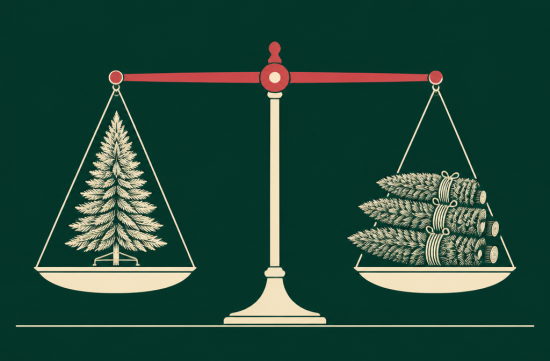
Thanksgiving is just around the corner. Trees are already set up at the entrance of the store. The same dilemma begins this year.
Should I buy a real tree or an artificial one? It seems like a matter of preference, but it's actually a calculation issue.
Last week, I received this question: "I spend nearly $100 on a real tree every year; wouldn't it be better to just buy an artificial one?"
That's a good question. Instead of guessing, let's break it down with numbers. I'll base it on last year's prices.
First, the price of real trees. According to reports from last December, the national average farm gate price was around $80 to $100. There's a significant difference depending on size and species.
There are also regional variations. Reports indicated that trees in Manhattan were priced at $300, while those in suburban New Jersey were around $140. It's hard to say that tree lots in major cities in California are cheap either.
Next, let's look at artificial trees. Last year, tariffs were a factor. The American Christmas Tree Association (ACTA) estimated that the price of artificial trees increased by 10-15%.
The examples provided by the association were specific. For a $300, 6.5-foot artificial fir tree, an additional $30-$45 was added.
The real tree side was relatively quiet. Reports indicated that most tree lots and wholesalers maintained prices at last year's levels. This was largely due to the fact that the trees are grown domestically, so they were not significantly affected by tariffs.
Now, let's do the math. If we assume an artificial tree costs $300 and a real tree costs $90 per year, the artificial tree wins in the fourth year. That's $270 after three years and $360 after four years.
If we consider a low-cost artificial tree priced at $64 from a big box store, it would win from the first year. However, we need to consider how many years such a product will last.
On the other hand, if you're looking at a premium pre-lit model costing over $500, you'd need to use it for six years to break even. The math is straightforward. You divide the price of the artificial tree by the annual cost of the real tree.
Another significant point is that once you buy an artificial tree, you're done. The price of real trees changes every year, but with an artificial tree, you only need to keep the receipt from the first year. Budgeting is definitely easier.
But it wouldn't be interesting if we stopped here. There are hidden costs that don't show up well in the calculations.
Real trees require a stand and water management. There are also gas costs for the round trip to the tree lot. If you factor in the cost of straps or plastic covers to secure it on your car roof, there are ongoing small expenses every year.
The needles from real trees also add to the cost. By January, they keep falling between the fibers of the living room carpet. The time spent vacuuming is ultimately my time.
For artificial trees, storage space is a cost. They take up a space in the garage or storage for 11 months of the year. This can be a real burden for those living in apartments.
Now, let's talk about the environmental aspect, which I really wanted to discuss. How many years do you need to use an artificial tree for it to be better in terms of carbon footprint than a real tree? Different studies provide different answers.
A life cycle assessment commissioned by ACTA in 2018 stated it was 4.7 years.
However, it's important to note that this association represents artificial tree manufacturers. It's worth remembering who commissioned the study. It's reasonable to be skeptical of numbers produced with industry funding.
A 2009 assessment from a consulting firm in Montreal found it to be 20 years. 4.7 years versus 20 years. That's more than a fourfold difference.
Why is there such a discrepancy? The outcome can vary significantly depending on how you dispose of the real tree and how far you drive to the tree lot.
Some analyses suggest that even driving just 10 miles can offset a significant portion of the carbon absorbed by the tree. So, buying from a nearby lot is a good practice.
And once you're done with a real tree, it must be sent to a recycling route. Our city operated free Treecycling drop-off sites at various parks and facilities from December 26 to January 9 last season.
On Saturday, January 10, there was also a one-time curbside pickup. The schedule for this year hasn't been announced yet, so be sure to check the city website in December. You must remove all decorations, lights, and stands before placing it out.
For reference, 80% of American households use artificial trees. According to an AP report, this ratio has remained the same for at least 15 years. However, very few artificial trees are made in the U.S., so prices fluctuate whenever tariff news comes out.
My conclusion is this: If you're buying an artificial tree, be prepared to invest in a sturdy one that will last over 10 years. Disposing of an artificial tree after three years is the worst for both your wallet and the environment.
Since they are made of plastic and metal, they are also nearly impossible to recycle. Ultimately, they end up in landfills. It's like buying expensive trash.
If you buy a real tree, make sure to purchase it from a nearby location and send it to Treecycling. The benefits disappear the moment it goes to a landfill.
If it were me, I would use the artificial tree I already have until the end. The most environmentally friendly tree is the one you don't buy new.
Which side are you on? Real tree, artificial tree, or potted tree?
Please vote in the comments. I'll summarize the results in the next post.
 MagicValley93








 Grow Your Gut Bacteria Well |
 choi family |
 content |

 Carolina border |
 Que Buena |

 Korean Blog |
 Fong Mr |
 Top Beaches |

 Coastal city |
 sasga now |
 Reno Cop |
 seouljung |
 bayaa |
 Good Hotels |
 heartwarming |
 Blogging with a Heart Like the Sun |
 peace |
 The Bread Lover Runs on Bread |
 yogurt 1 |
 Macon Boy |
 Joyce 77 |
 The Yellow |
 bluebird |
 Epoca News |
 Samttugi Grasshopper Noodle |
 kansan55 |
 Skyline |
 Investment Information News Update |