
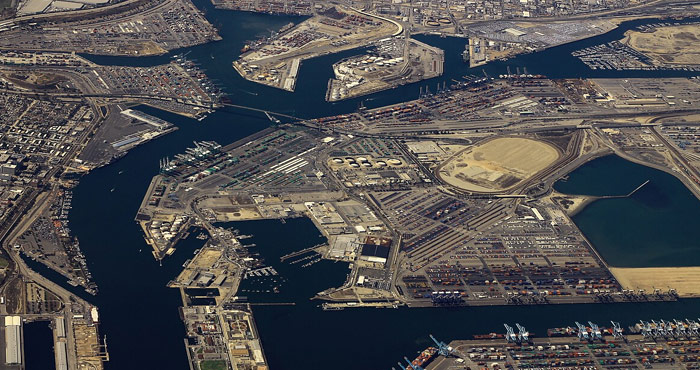
The Port of Long Beach is a large port located in California on the west coast of the United States, playing a dual role in logistics alongside the Port of Los Angeles (LA). It serves as a key gateway for cargo between Asia and the Americas, handling a tremendous volume of containers each year and establishing itself as a globally recognized logistics hub.
Scale and Status
- The Port of Long Beach is considered one of the 'busiest ports' in the United States. It is adjacent to the Port of Los Angeles, and the area is often referred to as the 'LA-Long Beach Port Complex.' Together, these two ports can be regarded as the largest maritime logistics hub in North America.
- Each year, it handles tens of millions of TEUs (Twenty-foot Equivalent Units) and serves as a gateway for products coming from Asian countries (China, Japan, South Korea, etc.). Its influence on the global shipping and import-export industries is immense.
Main Functions and Roles
- Container Logistics: The Port of Long Beach has well-developed container terminals, serving as a gateway for various consumer goods, automotive parts, and electronics. Thanks to terminals operated by major shipping companies, container loading, storage, and transportation are carried out quickly and efficiently.
- Support for Distribution and Processing Industries: Not only does it facilitate loading and unloading, but warehouses and distribution centers are located around the port, allowing for one-stop processing of repackaging, inspection, and transportation.
- Contribution to the Local Economy: Port-related businesses (loading, logistics, transportation, warehousing, customs, etc.) create significant jobs in the local economy and positively impact the development of surrounding commercial areas.
Environmental and Smart Port Policies
- The Port of Long Beach is striving to comply with environmental regulations and adopt eco-friendly technologies. It is expanding programs that use alternative energies such as electricity and natural gas for loading equipment and trucks, and it implements 'Cold Ironing' to reduce air pollution by using shore power while vessels are docked.
- Additionally, to enhance operational efficiency, it is adopting automated and digital systems, actively utilizing advanced technologies for smart logistics management, such as reducing truck waiting times and predicting cargo volumes.
Transportation and Logistics Infrastructure and Synergy
- Nearby the port, there are large logistics complexes and a network of railroads and highways, making transportation to the inland and the eastern coast of the United States convenient. Particularly, cargo is quickly delivered nationwide via trucks and freight trains.
- It collaborates organically with the adjacent Port of Los Angeles, forming a global maritime logistics hub. The synergy resulting from the connection of these two ports is enormous, with a significant portion of U.S. export and import cargo passing through this region.
Community and Future Outlook
- Given the significant economic ripple effects of port activities, cooperation with the local community is also an important task. Key issues include local environmental improvement, noise and pollution reduction, and traffic congestion alleviation, while simultaneously balancing port expansion projects and new logistics initiatives with the support and opposition of local residents.
- As long as global trade remains active, the status of the Port of Long Beach is expected to be maintained or further expanded. Especially with advancements in e-commerce and logistics automation, the transition to a 'smart and eco-friendly port' is anticipated to be a major focus.
The coastal city's unique scenery and the sight of large vessels navigating the port provide another attraction, making a visit to the port area an interesting experience when in Long Beach.







 moo moo |
 ultron78 |
 garlic bread |
 Sugar Cream Door Bulletproof Noodles |
 urbanmint |
 Korean Blog |
 Coastal city |
 Sammy Beach |
 Key spots |
 Tonky |
  viroma |
  cookie |
  Live and that's it |
  Alright Twain |
  eatontown blog |
  HAWAII Korean Church News |
  Amore |
  linex |
  Balancework |
  laro90 |
  MEDBIO American Doctor Blog |
  SWAT TEAM BLK |
  DREAM BIG |
  frostbite |
  330 Forever My Love |
  El Dorado |
  dralix58 |
  Gorama Round |
  Skydiving |