

Living in America, you sometimes encounter truly absurd situations.
Target is a well-known large corporation in the U.S., but yet again, something happened that makes you wonder, "How did this get approved?"
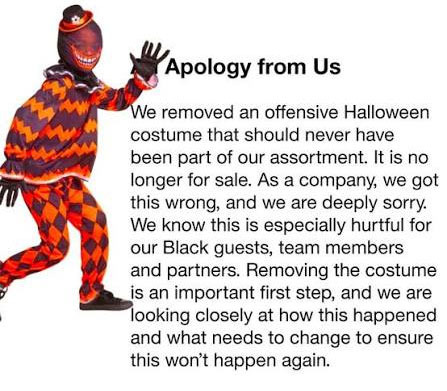
With Halloween approaching, a children's clown costume sparked significant controversy, leading to a halt in sales and an official apology.
Target acknowledged that the costume was inappropriate and should not have been included in their product offerings in the first place.
The problematic product was named 'Kids' Glows Under Blacklight Circus Clown Halloween Costume' and was priced at $25.
The clown outfit, which featured a mix of black and orange, came with black gloves and a small hat, and the printed face part had an exaggerated smiling mouth.
The controversy escalated when a product photo surfaced showing a Black child wearing the costume.
People in the U.S., especially within the Black community, immediately reacted, saying, "This is hard to see as just a clown costume."
This reaction stemmed from associations with blackface and minstrel show imagery, which have historically been used to mock Black individuals.
In those performances, exaggerated representations of Black skin, lips, and expressions were used, becoming a symbol of racial discrimination during the Jim Crow era. So, for those who have lived in America for a long time, it's understandable why this photo was received so sensitively.
People from Korea or those without background knowledge might look at the costume and think, "Isn't it just a weird Halloween clown?"
In fact, some people living outside the U.S. expressed confusion online about why this became a racial issue.
However, for those aware of the historical context in America, it was viewed very differently.
This made me curious: "Why would a large corporation like Target sell this product?"
It's not like a small local shop where the owner just brings in items to sell.
There must have been a process involving planning, designing, creating samples, and getting approvals.
Moreover, they had to hire child models, take photos, and create product pages to upload online, yet no one raised any concerns during these stages.
This aspect was heavily criticized during the controversy.
While Target did not specify who designed or approved the product, they stated they would closely examine their internal processes to prevent a recurrence.
Target's response was swift. They immediately removed the product from their listings and issued an apology.
They acknowledged that this incident could hurt Black customers, employees, and partners.
However, Target has faced significant controversy in recent years for scaling back its DEI (Diversity, Equity, and Inclusion) policies.
Some have pointed out that if people from diverse backgrounds had been involved in the decision-making process, this product likely would not have passed.
Of course, it's hard to argue that this costume was intentionally created for racist purposes.
This distinction needs to be made. The issue lies not in intent but in the outcome.
The fact that a product resembling sensitive imagery from American history was sold as a children's costume by a major retailer is the crux of the matter.
In the U.S., even the design of a single item can be difficult to understand without knowledge of the country's history.
What may appear as just a strange clown to a Korean person could evoke historical wounds for Black Americans.
Ultimately, a $25 children's Halloween costume has presented a significant challenge for Target.
It could have been as simple as someone in the meeting room saying, "Wait, I think this might cause a problem if we put it out like this?"
 LifeIsLabor
 Dream Box





 GOGO SING |
 Hajiwon Blog Hair Salon |
 tartbear |
 novapixel |
 NEXT ROUND |
 Until the Day It Gets Better |
 Agenda Center |
 Con Cheese |
 Enjoying Samba at Home |
 monorama tone |
  horse |
  moodansa 77 |
  zymit |
  maplefox |
  Fun Flex Life |
  hopeful |
  Reeno |
  Coastal city |
  meonetoo |
  Winter bear |
  Peach Jam Eating Laughter |
  Nando Raldo |
  American Man in a Mask |
  wendra |
  silver |
  bada2002 |
  horizon |
  Nanana Nanana Nanana |
  victoria jung |
  Kkikki Ppappa Shout Out Loud |