
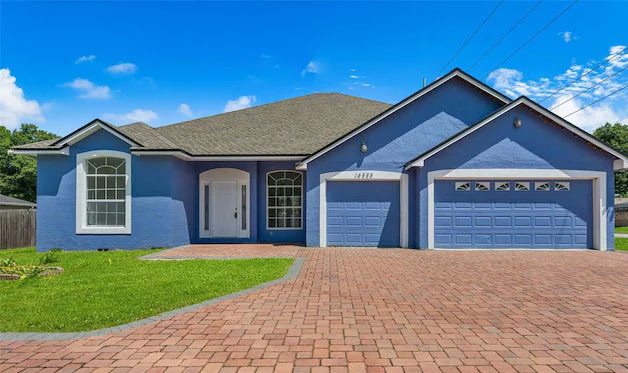
When living in Orlando, the first thing you often think about is housing.
Should I rent for a few years, or since I'm moving, should I just buy a house?
Looking at these numbers can get complicated, but if you break it down, the answer starts to become clearer.
Let's consider the median rent for a 2-3 bedroom in Orlando to be about $2,050 per month, and the median home price around $390,000. If we calculate the Price-to-Rent Ratio, dividing $390,000 by the annual rent of $24,600 gives us about 15.9.
Generally, a lower number indicates that buying is more competitively priced, but at 15.9, renting is not overwhelmingly advantageous. However, it doesn't mean you should rush to buy a house either. It sits in a rather ambiguous position that makes people think.
When you calculate the actual out-of-pocket expenses, it becomes more realistic. Let's say you put down 20%, which is $78,000, on a $390,000 house and borrow $312,000 at a fixed rate of 6.75% for 30 years. The principal and interest would be about $2,020 per month.
On top of that, you have property taxes and homeowners insurance. Especially in Florida, you shouldn't underestimate insurance costs when buying a house. The difference in insurance rates can be significant depending on the area and the condition of the home, and if it's a house with an HOA, that adds more costs. So simply thinking, "Rent is $2,050, but the mortgage is $2,020? Then I should buy," can lead to a completely different calculation.
When you add up the estimated costs, your monthly housing expenses could rise above $2,500. Plus, as a homeowner, maintenance costs for things like air conditioning, roofing, plumbing, and appliances come out of your pocket. When renting, if the air conditioning breaks, you just call management, but in your own home, you're the one making the call. You're also the one pulling out your credit card.
You also need to consider the $78,000 down payment. You could invest that money instead of buying a house. Assuming an average long-term investment return of about 7%, the opportunity cost cannot be ignored. Of course, investment returns are not guaranteed, and conversely, there's no assurance that home prices will continue to rise.
Orlando is a city worth watching in the long term.
The tourism industry is huge, and the population and job market are continually changing, so for those planning to stay long-term, there are plenty of reasons to consider buying a home.
However, thinking, "Since Disney is here, home prices will definitely go up," is a flawed mindset. Ultimately, real estate is about where and at what price you buy.
If I were moving to Orlando and didn't know the area well, I would consider renting for about a year. You need to experience the commute, endure the summer, and see the school and neighborhood atmosphere firsthand. A place that looks good on a map might not be great to live in.
On the other hand, if your job is stable, your kids' schools are set, and you plan to stay for at least five years, the conversation changes. With a Price-to-Rent Ratio of around 15.9, it's definitely worth crunching the numbers for buying a home.
Ultimately, deciding between renting and buying in Orlando isn't just about which is cheaper. You need to consider how long you plan to stay, whether tying up $78,000 in a house is acceptable, and if you can handle insurance and repair costs.
For those visiting Orlando for the first time, it seems wiser to take your time before rushing into a contract. Looking at the numbers and experiencing the neighborhood firsthand seems like the best way to save money in the end.
 NGTelecom
 AliAluAlo







 Smile Face |
 Helpful Life Stories |
 Casa Mia |
 Study Abroad Life Know-How Tips |
 pravix22 |
 You Only Live Once |
 Lando Mao |
 Sunshine Blog |
 truepixel |
  Kathy's Blog |
  Hae Naem |
  quatspace |
  Marisol |
  Glassroom |
  Granola |
  joyfull yang |
  Olivia's Blog |
  Living in America and Writing Essays |
  Piano Teacher Blog |
  bearcup |
  explorer |
  dictionary |
  Mr Bull Jung |
  radiant |
  Georgia 88 |
  Great TOWN NEWS |
  Open Flex Mind |
  Hartford Blog |