
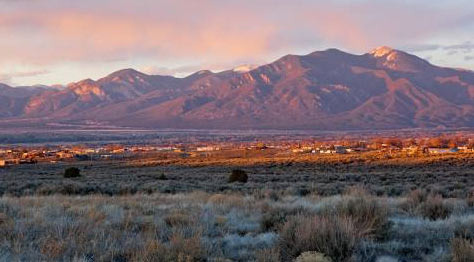
As you approach the red earth of the Mesa region, layers of thousands of years of time and numerous ethnic traces are stacked together. For about 10,000 years, Native American tribes such as the Pueblo, Navajo, and Apache have settled and lived on this land, and even today, their art and traditions continue throughout New Mexico.
Ruins like Chaco Canyon showcase the high level of architectural skill and community culture that people had at the time. Then, in 1598, Spanish explorer Juan de Oñate arrived in the area, marking the beginning of a new era. Spain established colonies here to spread Catholicism and control the Native Americans, with the center being present-day Santa Fe.
Perhaps that's why even today, throughout New Mexico's cities, there are Spanish-style churches, adobe architecture, and streets named after saints. In 1821, when Mexico gained independence from Spain, New Mexico briefly became Mexican territory, but during the U.S.-Mexican War in 1846, it was occupied by the United States and officially annexed in 1848 through the Treaty of Guadalupe Hidalgo. However, the Spanish language, Mexican culture, and Native American traditions did not disappear; rather, they enriched New Mexico's identity.
When New Mexico became the 47th state of the United States in 1912, it officially became part of the U.S., but it is still referred to as 'the most different state' within the country. This is clearly evident in its racial composition. As of 2023, about half of New Mexico's population of approximately 2.1 million is of Hispanic or Latino descent, the highest percentage in the United States.
These individuals primarily inherit cultures from Spain, Mexico, and Latin America, maintaining their language, food, faith, and family-centered values. Non-Hispanic whites make up about 36%, and Native Americans account for about 11%, with the Navajo, Pueblo, and Apache tribes being particularly representative. There are 23 Native American tribes residing autonomously throughout New Mexico, making this state a true multicultural laboratory within the United States.
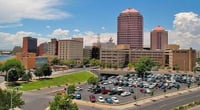
The major cities are Albuquerque, Santa Fe, and Las Cruces. Albuquerque is the economic center and the largest city in New Mexico, with developed scientific research institutions, universities, and the aerospace industry. Santa Fe is famous as a city of art and culture, with galleries and art museums lining the streets, earning it the title of "the artist's sanctuary." Las Cruces is an agricultural hub where traditional Mexican atmosphere coexists with modern sensibilities. New Mexico is vast but has a very low population density, so wherever you go, you will see expansive skies and barren plains.
Culturally, New Mexico is 'an America that feels unlike America.' The landscape, where Native American crafts, Pueblo traditional homes, and Spanish-style churches blend, is a sight hard to find in other states. The food culture is also unique. Green chili is a symbol and pride of New Mexico, topping everything from hamburgers to soups to pizzas. Locals often ask, "Red or green?" to share the identity of their food.
This place is a 'living history book' where time, culture, people, and nature are harmoniously intertwined. It is a place where Native roots, Spanish traces, Mexican passion, and American practicality are exquisitely blended. Thus, when you visit New Mexico, you will encounter 'another face of America.'




 rainyday |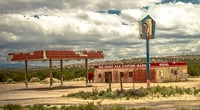
 Say Yes in English |
 Pointy |
 Southwestern |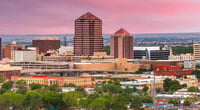
 U donn |
  Korean Mom |
  My NYC |
  moo moo |
  Mr Oh |
  forevergee |
  festival |
  manchester |
  constant |
  Leapfrog Move |
  vibranto |
  Tora Tora |
  yellowbutter |
  Dolly |
  US Embassy |
  NYC saladbar |
  Finding Superfoods |
  lightyear |
  song bang |
  vexomo |
  Indiana Jones |