

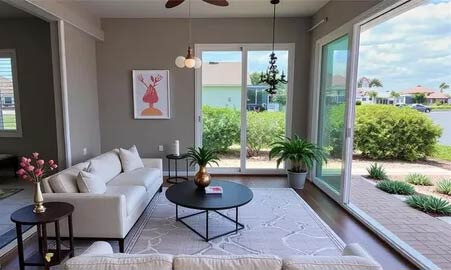
When listening to stories from those who have started their retirement in Fort Myers, it's surprising to hear how burdensome property taxes can be.
While working, the steady paycheck made it manageable, but after retiring and with income reduced, the situation changes. The house is owned outright, and the mortgage is nearly paid off, yet the property tax bill arrives every year without fail. On top of that, when homeowners insurance is added, owning a single home becomes quite a challenge.
In the summer of 2026, home prices in Fort Myers are hovering around the mid-$300,000 range.
Lee County property taxes also vary based on home value and various exemptions. Especially for those who have recently purchased a home in Fort Myers after retirement, it's important not to judge based solely on the taxes paid by the previous owner. After ownership changes, the tax assessment criteria can change, potentially resulting in higher taxes than expected.
This is why reverse mortgages often come up in conversations among retirees.
Simply put, it's a way to borrow money using the equity in your home. In a typical mortgage, you borrow money from a bank and pay it back monthly, but with a reverse mortgage, it's the opposite. Homeowners aged 62 and older who meet certain conditions receive money against their home as collateral, and generally do not repay principal and interest monthly.
There are various ways to receive the funds. You can take a lump sum, receive a set amount monthly, or use a line of credit that you can draw from as needed. This can sound quite appealing to those who are short on cash after retirement, as it can help cover living expenses or pay annual property taxes.
However, there is a very important point to consider.
Receiving a reverse mortgage does not eliminate property taxes. Homeowners still need to pay property taxes and maintain homeowners insurance. The home must also be properly maintained and used as the primary residence. If property taxes or insurance premiums cannot be paid, serious issues can arise.
So, thinking that getting a reverse mortgage will solve all problems related to property taxes is misleading. In reality, it's about converting the assets tied up in the home into cash to create the means to pay property taxes.
Not everyone can qualify for this. The typical HECM requires you to be 62 or older, and the home must be your primary residence. If there is still a significant existing mortgage, that must be addressed first. Lenders will also assess whether you can continue to manage property taxes and insurance premiums in the future. Depending on the situation, a portion of the loan may be set aside specifically for tax or insurance payments.
The costs can also be quite substantial. There are loan-related fees, appraisal fees, closing costs, and mortgage insurance premiums. Most importantly, just because you don't pay principal and interest monthly doesn't mean the debt disappears. Over time, interest accrues, increasing the loan balance, which reduces the equity left in your home.
For those who want to pass their home down to their children, this is something to consider carefully. You may need to sell the home later to settle the loan balance. On the other hand, a typical HECM is non-recourse, meaning that if the debt exceeds the home's value under certain conditions, the heirs are not required to pay the excess out of pocket.
Before looking into reverse mortgages, it's advisable to check if you qualify for Florida's Homestead Exemption or additional property tax benefits for seniors. If these programs can reduce your taxes, you might not need to tap into your home equity right away.
Ultimately, for someone who has a home but is short on cash after retiring in Fort Myers, a reverse mortgage can be one option. However, it is definitely not a way to receive free living expenses. It is more of a financial product that allows you to access the assets accumulated in your home ahead of time.
After retirement, you need to consider how many more years you might live, how long you will stay in this home, and what you want to leave for your children. Therefore, a reverse mortgage is not a simple decision that can be made with just a quick calculation. It's important to thoroughly compare whether using the equity of a home you've built over decades is truly beneficial, especially when faced with a few thousand dollars in property taxes, and to explore other options before making a decision.
 Solo214
 mint1969





 Sugar Cream Door Bulletproof Noodles |
 urbanmint |
 |
| 
 Premium Gas Camp |
 CA Real Estate |
 Joyce 77 |
 Vision XT |
 Blog Korea |

 Way to easy |
  horizon |
  Nanana Nanana Nanana |
  victoria jung |
  Kkikki Ppappa Shout Out Loud |
  Lululala |
  Toaster Pizza Magic Show |
  nortrix |
  Mau Nui |
  novapixel |
  fixed |
  AL ALASKA |
  amola |
  History Repeats Itself |
  Doori Ark |
  Rainbow Bridge to the Sky |
  Sunny Fullerton |
  U.S. Weather Bureau News |
  GOGO SING |