
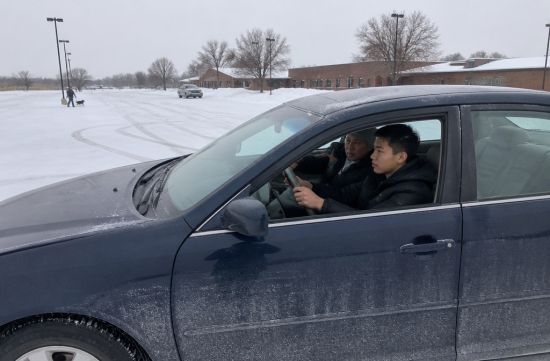
On the morning of the first snowfall, when a child who has only had their permit for a few months asks for the car keys, parents feel conflicted. If they say no, the child will eventually need to drive alone, but if they say yes, there's anxiety.
To put it simply, the first winter is not something to avoid but an opportunity to practice. However, there is an order and method to follow.
First, let's look at one number. According to North Dakota's Vision Zero data, drivers aged 14 to 19 make up 6% of all licensed drivers but were involved in 21% of all accidents.
Statistics also show that 44 teens have died in car accidents over the past five years. In a small state, this number is significant.
So, let's clarify the laws first. In North Dakota, you can obtain an instruction permit at age 14 with parental or guardian consent.
During the permit period, a licensed driver who is at least 18 years old and has at least three years of driving experience must sit next to the permit holder. Additionally, 50 hours of supervised driving must be logged.
Here's an important point to note. This 50 hours must include night driving and various road conditions, which essentially means you should include winter practice.
If you obtain a restricted license before age 16, there will be limitations. You cannot drive from 9 PM or after sunset until 5 AM, except for work, school, or religious events.
Using a cellphone, even hands-free, is prohibited while driving. In winter, the sun sets early, so parents should be aware that their child may have less time to drive than expected.
Details may change, so please verify with the NDDOT licensing office or the official website.
Now, how do you actually practice? I recommend starting in an empty parking lot. A church or school parking lot on a Sunday afternoon after it has snowed is ideal.
Of course, since it's private property, you should get permission from the management beforehand. Choose a wide area without curbs or light poles.
There are three things to do there: starting slowly, intentionally braking hard, and handling the steering when skidding.
Most modern cars are equipped with ABS. When you brake hard, the pedal vibrates and makes a noise, which can surprise inexperienced drivers and cause them to lift their foot off the pedal.
You need to help them understand that this is normal operation, not a malfunction. It's important to keep pressing the pedal down firmly, even if it shakes.
When the back starts to skid, teach them to look in the direction they want to go and gently turn the steering wheel that way. It's better to experience this once at 10 miles per hour than to explain it a hundred times. If parents demonstrate first, the child will feel much less anxious.
The second step is practicing on neighborhood roads with less traffic. Here, focus on maintaining distance from other cars and slowing down at stop signs.
AAA recommends keeping a distance of 5 to 6 seconds from the car in front on snowy roads, and up to 8 to 10 seconds on icy roads. This is two to three times the 3 to 4 seconds used on dry roads.
At first, it may seem too far. I felt the same way initially, but when you skid at a stoplight, that distance doesn't feel long at all.
When the car in front passes a sign, count out loud: one, two, three. The child may find it annoying, but this is the most effective method.
AAA also advises looking 20 to 30 seconds ahead. Don't just focus on the bumper in front; look at the upcoming intersection and brake lights ahead.
When approaching a curve, the order should be: brake first, then steer, and finally accelerate. Developing the habit of braking while in the curve can lead to accidents in winter.
The third step involves driving on main roads and at night. Parents must be in the car, and it's best to start on clear weather days.
Checking road conditions before starting should also be part of the practice. You can check real-time road information using the NDDOT's ND Roads app or by calling 511.
A No Travel Advisory does not mean the roads are closed, but it is a warning not to travel. If this alert comes up, going out to practice is not bravery but a judgment error.
Finally, prepare the car. Make sure the child packs a blanket, gloves, a phone charger, an ice scraper, and a small shovel in the trunk.
They should also develop the habit of refueling before the tank drops below half. Make it a routine to clear snow off the windshield and roof before starting each time. In North Dakota winters, stopping on the road can quickly become dangerous.
To be clear, I believe it's much better for parents to be in the passenger seat and fill the winter hours than to take the child out of the driver's seat during their first winter. I think the law requiring 50 hours of supervised driving under various road conditions is for this reason.
It's better for the child to experience skidding next to mom or dad than to face snowy roads alone for the first time. Please look for an empty parking lot this weekend to start practicing.
 midnightforestwalker1947
 JellyMechanic





 Augusta 90 |

 Pointy |

 rissa |
 Gomo Nim |

 lattepop |

 reliable |

 buddydakota |

 General Knowledge Blog |
 Shining Our Own World |
 Raymond K. |
 gravity |
 714 Success Era Real Estate |
 Investment Beginner Company Information Encyclopedia |
 musicque |
 The Gelaton |
 ovelion |
 Chicagonian |
 Freedom Yea |
 AZ Road Master |
 glenix39 |
 Something is popping in the situation |
 orvella |
 vella |
 comets |
 Banana |
 Yes Dorian |
 Minnesota Sonata N |
 zentar |