
Last month, I opened my electric bill and briefly grabbed my calculator again. The amount was significantly different, even though my usage was similar to last year.
I wondered if it was just my imagination, so I looked up the data. To cut to the chase, it's not just my imagination.
According to ElectricRates.org, which compiles EIA data, the average residential electric rate in Ohio was around 19 cents per kWh in April 2026. A year earlier, it was around 16 cents, marking a double-digit increase.
During the same period, Ohio was noted as having the largest increase in residential rates in the nation. Honestly, I was a bit surprised by this point.
So, why did it rise so much? If you look at the bill, it breaks down into two main parts.
The first is the cost of purchasing electricity itself, which is the supply portion. The Price to Compare for Illuminating Company customers falls under this category.
This benchmark price was around 9 cents per kWh at the beginning of the year, but according to Cleveland city data, it rose to 11.11 cents starting in June. This increase is influenced by the results of the PJM power grid's capacity auction, which began affecting rates from June 2025.
The second part is the distribution charge, which covers the maintenance of power lines and poles. PUCO decided in February this year to increase CEI's annual revenue by $48.7 million, and the new rates took effect on March 1.
But that's not all. Three FirstEnergy subsidiaries submitted a three-year rate increase proposal to PUCO in May.
According to consumer protection agency OCC, a CEI household using 1,000 kWh per month will see an increase of $5.15 annually upon approval. This starts in 2027 and is still under review.
I tend to believe in market principles. However, the issue of rising prices due to increased demand is different from the layering of rate increase proposals, so I hope the regulatory agencies will keep a close eye on this.
Now, let's get practical. I will outline the methods I have personally tried or those recommended by official agencies in order.
Step 1 is to check your Price to Compare on your bill. This number is the baseline for all comparisons.
Step 2 is to open the Apples to Apples chart on energychoice.ohio.gov, operated by PUCO. You can compare the kWh rates, contract lengths, and whether they are fixed or variable at a glance.
Be cautious of teaser rates that are only low for the first few months. Evergreen contracts that automatically renew at a higher price after the contract ends are similar.
OCC advises that early termination fees can exceed $100. Check if there are any termination fees on your current contract, and be sure to keep the signed contract.
Many contracts allow cancellation without a fee within seven days. OCC also recommends not signing a contract on the spot with a salesperson who comes to your door.
Step 3 is to check the city's bulk purchasing program. Cleveland is running an aggregation program with SOPEC from August 2026 to July 2027, so compare the rates on the city website with the benchmark price.
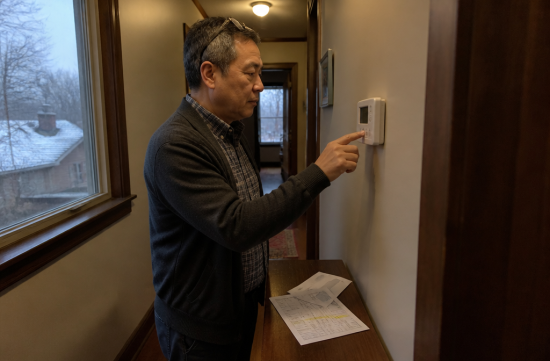
Step 4 involves actions you can take inside your home. The U.S. Department of Energy explains that lowering your thermostat by 7 to 10 degrees Fahrenheit for eight hours a day can save you up to 10% on heating and cooling costs annually.
I have set my programmable thermostat to lower the temperature only during sleeping and away times. The key is not to endure all day but to divide the time periods.
Step 5 is a support program that families in tight financial situations should know about. This is not something to be ashamed of; it's about properly utilizing a system created by taxes.
The regular HEAP will accept applications from July 1, 2026, to May 31, 2027. The Winter Crisis Program, which provides emergency assistance during winter, opened on November 1 and will run until March 31 next year.
The Winter Crisis Program targets households with incomes below 175% of the federal poverty line that have received a shut-off notice or have already been disconnected. It's also good to know about PIPP Plus, which requires a set monthly payment based on income.
Applications can be made at energyhelp.ohio.gov or through local energy assistance agencies. If you're worried about your parents' bills, checking on their behalf is also an option.
To summarize, here's the order: check the benchmark price, compare suppliers, check the city's bulk purchase, adjust the thermostat, and look into support programs.
If it were me, I would spread out my bill this weekend and start with Step 1 and Step 2. It only takes about 30 minutes, and that half hour could determine the amount on your bill all winter long.
We can't stop the rates from rising individually. However, we can choose where to shop and when to use less.
 BerryRocket
 DJWashington



 Nevada Vegas UNLV |

 Things to know |
 West Kong |

 havero70 |

 Grow Your Gut Bacteria Well |

 solid90 |

 uplifted |




 radiant |
 Raymond K. |
 gravity |
 714 Success Era Real Estate |
 Investment Beginner Company Information Encyclopedia |
 musicque |
 The Gelaton |
 ovelion |
 Chicagonian |
 Freedom Yea |
 AZ Road Master |
 glenix39 |
 Something is popping in the situation |
 orvella |
 vella |
 comets |
 Banana |
 Yes Dorian |
 Minnesota Sonata N |
 zentar |
 mykiwi blog |