
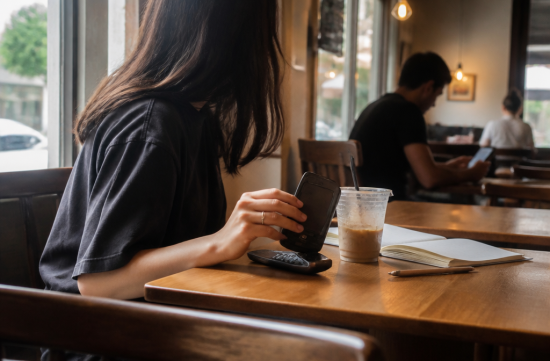
Last week, while sitting by the window at a local café, I heard an unfamiliar sound. It was a click, the sound of something folding.
Turning my head, I saw a young man, likely a college student, closing a small flip phone. Next to his iced coffee was just a notebook and a pencil.
Honestly, at first, I thought he was using it as a temporary phone because his smartphone was broken. But after seeing similar scenes a few more times, my perspective changed.
Do you have any young people like this around you? Recently, American media has been treating this as a trend.
These devices are often referred to as dumbphones. They allow calls and texts but lack social media feeds or have very limited app stores.
Curious about the reasons, I looked for some numbers. The Pew Research Center conducted a survey of 9,750 American adults from May 26 to June 1 this year, with results released in early September.
53% of all adults reported that they spend too much time on their smartphones. 36% said their usage was just right.
Notably, among those aged 18 to 29, 70% said they spend too much time on their phones, and 42% said they are almost always attached to their smartphones.
Teenagers are not much different. In a fall 2023 survey of 13 to 17-year-olds, 38% reported spending too much time on their smartphones, with 44% of girls saying so compared to 33% of boys.
Sleep issues are also mentioned. Among those under 30, 62% said smartphones negatively affect their sleep, and this was the only age group where a majority felt this way.
This means that the younger generation uses smartphones the most while also being the most aware of the problems associated with them. The choice of flip phones seems to stem from this contradiction.
There have been many attempts to cut back. In the same survey, 45% of respondents said they tried to reduce their usage in the past 12 months, and 58% of those under 50 attempted to do so.
The results were not very encouraging. Only 25% of those who tried said they succeeded very well, while 23% reported not being very successful.
This suggests that willpower alone is not enough. Even with app timers, a single tap can disable them.
Flip phones address this issue mechanically. If it takes multiple button presses to type a single letter, there's no reason to hold onto it for long.
Notification fatigue is often cited as a reason. Reports have surfaced in various media about young people seeking quieter devices due to being overwhelmed by constant notifications.
There's also an aesthetic aspect. The clunky keypads and low-quality cameras are seen as unique traits on social media.
It feels strange to see items I used when I was younger making a comeback. Back then, everyone wanted to upgrade as quickly as possible.
Companies have not missed this trend. In 2024, HMD partnered with Mattel to release a pink Barbie flip phone, and models like the Nokia 2660 Flip continue to appear on recommendation lists.
Prices vary widely. The Light Phone III, a representative of minimal phones, was priced at $799 when it launched in March 2025.
It's a bit ironic to buy a device as expensive as a smartphone to use less of a smartphone. Still, it indicates a strong desire for change.
Schools are also taking action. The Hawaii Board of Education adopted a statewide policy regarding public school students' cellphone use on February 12 this year.
Starting in the 2026-27 school year, elementary and middle school students will not be allowed to use cellphones during school hours. High school students will be prohibited during class time, with lunch and break times left to the school's discretion.
Of course, not everyone is switching to flip phones. There are too many inconveniences without smartphones, such as maps, banking apps, school assignments, and workplace messaging.
So, when reading related articles, it's often suggested that a more realistic solution is to carry a flip phone only during designated times rather than completely giving up smartphones.
If you're interested, there's no need to start big. Just check if you can transfer your existing number and if your carrier supports that model, and initially, try taking it out only for evening walks or weekend outings.
That day, the young man slipped his flip phone into the back pocket of his jeans as he left the café. Strangely, that silhouette looked very light.
I welcome this trend. It seems to reflect a desire to set personal boundaries with technology rather than rejecting it outright.
However, one thing is worth remembering. It's more sustainable to decide how to use devices rather than just changing them.
What about you? If you count how many times you opened your phone today, you might be quite surprised.
 GatoradeShot



 Let's Be Like a Salt-like City Person |
 Springs Korea |
 US Legal Consultation on Trials |
 Study Abroad Life Know-How Tips |
 Best Frozen Yogurt |
 HAWAII Korean Church News |

 Public School Education System |
 Hawaii Tourist Information |

 Unknown Dog Walk blog |
  whiskerbread |
  Yo Lock Me Up |
  people are |
  pecantop |
  self-evaluation |
  |
|  stalion |
  anchor |
  Smile Face |
  The Long Shot |
  Anjollinya Blog |
  Investment Beginner Company Information Encyclopedia |
  sweetfox |
  ceporta |
  H Leader |
  My tracks |
  Yes Dorian |
  novent |
  calviro |
  Enjoying Samba at Home |