
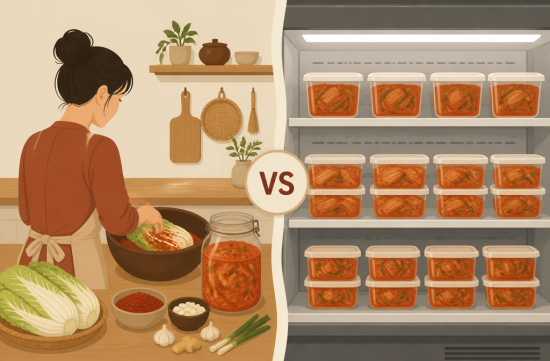
Last week, I picked up some packaged kimchi from the refrigerated section at the grocery store and stopped in my tracks when I saw the price tag.
A 4-pound container of napa cabbage kimchi was $18.49, which breaks down to $4.62 per pound.
The small jar next to it, which is 10 ounces, costs $3.18, but when converted to pounds, it's actually more expensive—over $5.
This means that even for the same brand, the larger container is a better deal than the small jar, but neither option was cheap.
I almost tossed it into my cart, but then memories of my family making kimchi with dozens of napa cabbages came to mind, and I changed my mind.
When I got home, I started calculating the cost of the ingredients one by one.
A 2.7-pound head of napa cabbage costs $4.79, which is only $1.77 per pound.
All I need is some gochugaru, garlic, fish sauce, shrimp paste, and sugar, with gochugaru costing $14.96 for 1.1 pounds, and a small bottle of fish sauce around $4.72.
At first glance, the cost of these seasonings might seem high compared to the cabbage.
However, the key point is that once you buy these seasonings, they last for several batches of kimchi.
When making kimchi from one head of cabbage, you don't use the entire bottle of gochugaru or fish sauce; you only need a small amount, so after making it two or three times, you've already made back your investment.
On the other hand, when you buy kimchi, you have to pay the full price every time you want to eat it.
Once you finish a container, you have to shell out another $18.49, so for households that eat kimchi often, this difference adds up quickly.
In my experience, one bag of gochugaru can easily make kimchi from three or four heads of cabbage.
The same goes for fish sauce; once you buy a bottle, it lasts for several months.
So, while the initial ingredient cost might seem high, from the second or third batch onward, you're only paying for the cabbage.
After considering all this, I understand why older generations were so serious about making kimchi.
Of course, when you factor in the time and effort, buying kimchi is definitely more convenient.
The process of salting, rinsing, and mixing the seasonings takes a whole day, so for busy people, this time is a real cost.
Still, I believe that handling these things myself is ultimately more rewarding than relying on others.
Learning and mastering the process of making it myself is true skill, and I think this principle applies to managing a household as well.
Moreover, when you make it yourself, you can adjust the saltiness, spiciness, and types of seafood to your taste, so that freedom is also significant.
You can use only shrimp paste instead of fish sauce, and if you want to reduce the spiciness, you can simply adjust the amount of gochugaru.
Store-bought kimchi varies in saltiness and fermentation levels by brand, so you might end up spending more trying to find one that suits your taste.
Of course, during busy times, ready-made kimchi can be very useful.
Especially when buying a large container of napa cabbage kimchi, the price per pound is lower than for small jars, so in those cases, it's better to choose one large container over several small ones.
However, if you keep one or two heads of cabbage in the fridge and make kimchi when you have the time, you'll find that it doesn't take as much effort as you might think, and the costs are definitely reduced.
Sharing the kimchi you make with neighbors builds relationships and ultimately reduces the money you spend outside, making it a win-win situation.
Rather than waiting for someone else to lower prices, I feel much more at ease reducing my own expenses where I can.
In the end, I believe that managing a household is a game where those who earn and save for themselves come out on top.
This weekend, I plan to buy cabbage again and make kimchi. I don't want to stop in front of the price tag at the grocery store again.








 Anna Life |
 JESIKYEOALBA BLOG |
 Dad's Tribute TC |
 Glow Yo |
 U.S. Retirement Pension Information |
 berrypup |



 Fruitop |
  Exploring American Life Information |
  sing sing |
  ORAVEZIN Oppa |
  Lego My Ego |
  logger |
  Conflite Teacher |
  summita |
  Ari Songhan American Immigration Life |
  marketbox |
  Investment Campus Home Ownership |
  yentra |
  Iowa Egen Aunt |
  donut33 |
  gravity |
  American Golf Course Travelogue |
  There Are Such Things in the World |
  Agenda Center |
  digital |