

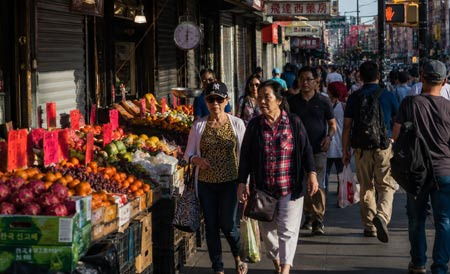
Most visitors to New York initially focus on Manhattan.
This is because world-famous attractions like Times Square, Central Park, and the Empire State Building are all located there. However, if you want to see the true essence of New York, I would recommend starting with Flushing instead of Manhattan. Located in the northeastern part of Queens, Flushing is not just a neighborhood with a large Asian population. It is a representative multicultural area of New York where various immigrants have gathered for decades to create and develop their own cultures.
Upon arriving in Flushing, the first thing you notice is the diversity of languages. It is common to hear more Chinese and Korean than English on the streets. Store signs are also more prominently displayed in Chinese and Korean than in English.
First-time visitors often remark, "Is this really America?" This reflects how Flushing has formed a unique identity within the United States.
Currently, the central axis of Flushing can be said to be the Chinese community. The area around Main Street has developed into one of the most prominent Chinese commercial districts in the U.S. While Manhattan's Chinatown was once the center of New York's Chinese community, many now consider Flushing to be the new hub. Especially with a steady influx of immigrants from mainland China, both the scale of the commercial area and the population have grown significantly.
As you walk down the streets, you will find a dense concentration of Chinese bakeries, dim sum restaurants, hot pot places, herbal medicine shops, and large markets. Many banks, real estate offices, hospitals, and accounting firms offer services primarily in Chinese. While Cantonese used to be the dominant language, the proportion of Mandarin speakers has increased significantly, changing the linguistic landscape of Flushing.
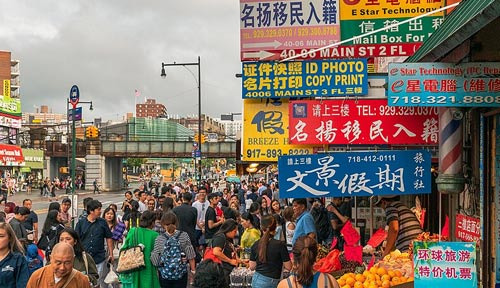
However, describing Flushing solely as a Chinese community is only half the story.
Korean residents have also played a significant role in the development of this area over the years. In fact, Flushing has grown to be one of the centers of the Korean community in New York. At one time, it was referred to as the largest Korean commercial area on the East Coast, and its influence remains strong today.
Along Northern Boulevard and Union Street, you will find a concentration of Korean restaurants, bakeries, hospitals, pharmacies, hair salons, accounting firms, and real estate companies. The Korean infrastructure is well established, allowing residents to live comfortably using only Korean, and various services to assist new immigrants are easily accessible.
Just looking at the food options reveals the size of the Korean community in Flushing. From sundubu jjigae, seolleongtang, naengmyeon, gamjatang, chicken, to sushi and snack shops, the choices are comparable to those in bustling areas of Seoul. There are also large markets and side dish shops selling Korean ingredients, providing a nostalgic environment for Koreans who have lived in the U.S. for a long time.
Recently, there has been a steady increase in residents of Indian, Pakistani, and Bangladeshi descent. As a result, Flushing has evolved into a vast living area where multiple Asian cultures coexist, rather than being a community of a single ethnicity. It is common to see Korean restaurants, Chinese hot pot places, Taiwanese bubble tea shops, and Indian grocery stores operating side by side on the same street.
The greatest charm of Flushing lies in this natural coexistence. It is not an exaggeration to say that it is a place where the diversity that New York boasts is most vividly displayed. People with different languages, cultures, and religions live in the same area, forming their own communities.
The economic impact cannot be overlooked either. Flushing is home to numerous immigrant-owned businesses, forming a significant economy in real estate, finance, healthcare, and the restaurant industry. One reason why the Flushing commercial area remains relatively active even during economic downturns in New York is due to this strong community foundation.
For tourists, Flushing offers a unique experience. Korean tourists visit to find authentic Korean cuisine, while visitors from mainland China or Taiwan come to enjoy their hometown foods. Local New Yorkers also frequently visit to explore the area's culinary gems.
Ultimately, Flushing is not just a neighborhood with a large Asian population. It is a space where immigrants start new lives, different cultures meet, and a new face of New York is created. If Manhattan represents the glamorous face of New York, Flushing can be seen as a place that showcases the realistic and vibrant life of the city.
Seeing the streets filled with diverse languages, foods, and cultures helps one naturally understand why America is called the "land of immigrants."
 CloudPopcorn
 MomsThing
 BaguetteSwim




 ultron78 |
 garlic bread |
 Sugar Cream Door Bulletproof Noodles |
 urbanmint |
 |
| 
 Whisper |
 MintO |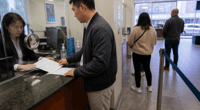
 nova nova |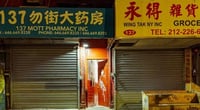
 TwinBee |
 Living in the Eastern United States |
  Finding Superfoods |
  lightyear |
  song bang |
  vexomo |
  Indiana Jones |
  meloncat |
  novapixel |
  mortrix |
  Esther 1983 |
  fortbliss |
  Moscow Kim |
  My Two Way |
  toastyfox |
  FLORIDA Acus |
  tracker |
  TONTON COFFEE |
  sunrise |
  uplifted |
  Folding Instructions |