

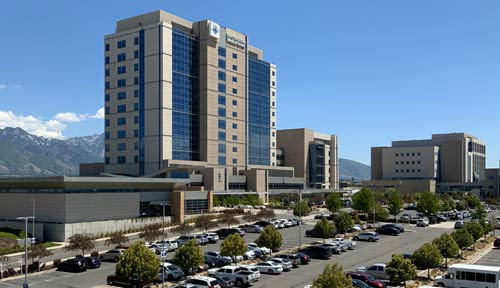
When looking into hospitals in Salt Lake City, the name Intermountain Medical Center often comes up alongside University of Utah Hospital.
Specifically, it is located in Murray, just south of Salt Lake City.
It's about a 15-20 minute drive from downtown SLC, making it one of the major hospitals serving the entire Salt Lake Valley.
The importance of this hospital is not just due to its size.
Intermountain Medical Center is a flagship facility of Intermountain Health, boasting over 500 licensed beds.
Given that Intermountain Health is a large healthcare system in Utah, you will frequently encounter hospital and clinic signs in the area.
It is particularly strong in the fields of cardiology and vascular health. The Intermountain Medical Center campus is equipped with specialized medical staff and facilities for heart and vascular diseases, handling everything from heart surgery to heart failure, arrhythmias, and complex vascular treatments. Heart conditions often require multiple specialists to work together, and this is where the advantages of a large medical center become evident.
Facilities capable of responding to emergencies are also a crucial aspect. It has a sophisticated emergency and trauma care system that can handle patients with severe injuries from serious traffic accidents or critical illnesses that local hospitals may struggle to manage.
Another noteworthy aspect is its role as a teaching hospital. Intermountain Medical Center is not just a place for patient care; it also participates in medical education and clinical research. When evaluating top hospitals in the U.S., factors such as the level of medical staff, treatment outcomes, patient safety, and educational and research capabilities are considered, which is why this aspect is important.
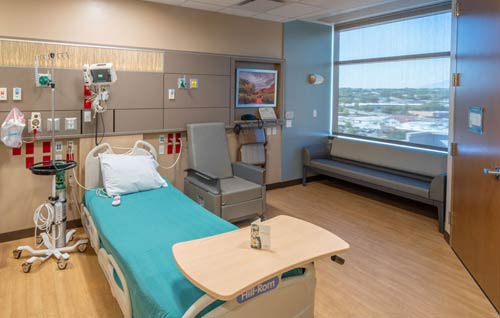
The overall evaluation of Intermountain Health is quite positive. In 2026, several affiliated hospitals received high marks in national hospital evaluations.
Ultimately, it's not just about one well-run hospital; there is a vast healthcare network connecting hospitals, specialty centers, and clinics throughout Utah.
This is quite convenient for those living in SLC.
Typically, you would see your primary care physician at a nearby Intermountain clinic for check-ups, and if more specialized care is needed, you would be referred to a larger hospital or specialty center. The ability to continue care within one healthcare system can be especially convenient for those requiring long-term treatment.
Compared to University of Utah Hospital, there are some differences in character.
While University of Utah Hospital is a typical academic hospital focused on research, education, and complex treatments for rare diseases, Intermountain Medical Center feels more like the central hospital of a vast regional healthcare network.
So, for those considering a move to SLC and worrying about the healthcare environment, there is more reassurance than one might expect. To the northeast is University of Utah Health, and to the south in Murray is Intermountain Medical Center.
When young, people often choose a city based on restaurants, jobs, and housing prices, but as they age, the presence of a proper large hospital nearby becomes increasingly important.
In that regard, Intermountain Medical Center is one of the less visible advantages of living in Salt Lake City.
You can forget about its existence in everyday life, but knowing that such a large medical center is nearby can be very reassuring when a significant health issue arises.
 SunnyTiger
 SkyBreeze







 Diana Blues |

 Dragon Lee |

 Churros Train Conductor |

 Tora Tora |

 neroyo |

 Tan Sol |

 morvex37 |

 AliAluAlo Blog |

 loran |
 The Gelaton |
 Twist Kim |
 berlon93 |
 Physical Laws and Science |
 good thinking |
 Solo Yolo |
 Mr Oh |
 laro90 |
 San Diego TOP Idol |
 Round and Round Children's Song Kingdom |
 American Golf Course Travelogue |
 MEDBIO American Doctor Blog |
 Hot Seat Driver |
 bryvexi |
 koala organic farm |
 riverstone |
 My Antonio |
 California Information News |
 chilli chilli |
 Moon Su San |