

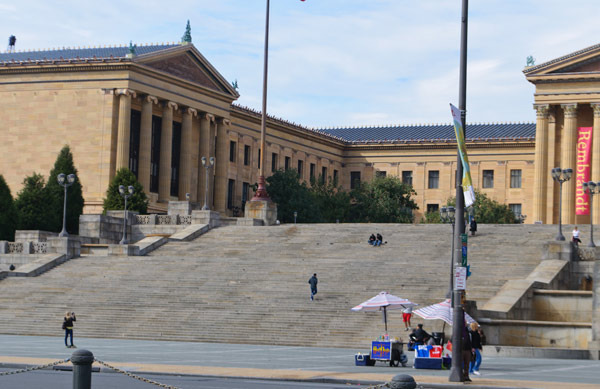
Above all, the exterior is a work of art in itself. The neoclassical building, modeled after the Parthenon of ancient Greece, gives a grand and majestic impression. The massive columns and golden roof come together, standing like a piece of art under the Philadelphia sky.
What has made this museum globally famous is the 'Rocky Steps' in front of it. The scene where Sylvester Stallone runs up these steps in the movie 'Rocky' remains legendary to this day.
Every day, countless tourists recreate that scene, taking commemorative photos, and the area in front of the Rocky Balboa statue at the bottom of the steps is bustling with people striking the "Rocky pose" for pictures.
However, the true charm of this museum lies in its world-class collection that encompasses art from Europe, Asia, and America.
In the European galleries, you can encounter masterpieces by greats like Leonardo da Vinci, Rembrandt, Van Gogh, and Monet. From Impressionism to the Renaissance, it feels like you are visually experiencing a history of art.
The Asian galleries are also remarkably well-curated. They feature a wide range of exhibits, including Japanese woodblock prints, Chinese ceramics, and traditional Korean crafts, with the Korean section showcasing Joseon-era ceramics, folding screens, and hanbok embroidery, attracting significant interest from foreign visitors. Moving towards the American galleries, you can see works by Philadelphia-born artists like Thomas Eakins and Mary Cassatt.
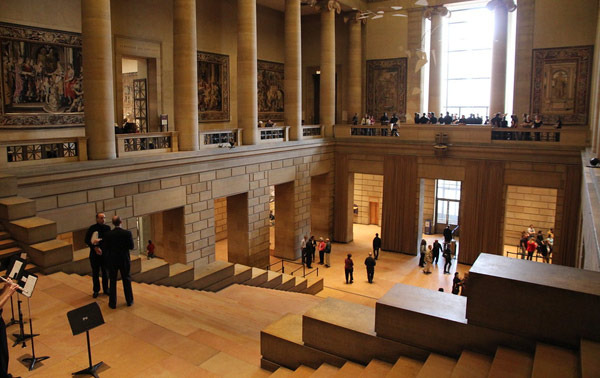
The museum is not just a place for exhibitions; it is a vibrant cultural space where new exhibitions and experiences are constantly taking place.
Special exhibitions featuring world-renowned artists like Picasso, Frida Kahlo, and Marc Chagall are held regularly, and experimental works by contemporary artists are often introduced. Among the exhibition spaces, the 'Living Room Gallery' recreates traditional European and Asian living rooms, giving visitors a sense of time travel.
There are various ways to explore. You can freely wander around using an audio guide, or if you join a docent tour, you can learn more about the historical background and hidden stories of the artworks. Programs for family visitors are also well-organized, including creative workshops for children, art explanations, and experiential programs that stimulate children's imaginations.
After viewing the exhibitions, you can relax at the museum café with coffee or a light meal. The café, with its luxurious atmosphere, has terrace seating overlooking the museum, making it a perfect spot to take a break after enjoying the art. The museum gift shop also offers a variety of art-related books, posters, and souvenirs, making it easy to take home a small memento.
Admission is $25 for adults, $14 for students, and free for children under 18. Notably, on the first Sunday of each month and every Friday evening, you can enter under the 'Pay What You Wish' system, allowing everyone to enjoy art without financial burden.
Operating hours are from 10 AM to 5 PM, Tuesday through Sunday, with extended hours until 8 PM on Fridays. The museum is closed on Mondays, so it's best to check before visiting.
Transportation is convenient. You can easily arrive using SEPTA buses or the subway, and there are parking options at the museum or nearby paid lots. Surrounding attractions include the Rodin Museum, Franklin Institute, and various sculptures and fountains along Benjamin Franklin Parkway, making it ideal for a full day of cultural exploration.
Ultimately, the Philadelphia Museum of Art is not just a place to view art; it is a location where you can feel the cultural heartbeat of the city.
It is a place to feel the passion for life while running up the Rocky Steps and to deepen your contemplation while appreciating world-class art inside.

 candytip |
 Gold Bar |
 Pirate Ship Popcorn Maker |
 Montgomery Mom |
 Anjollinya Blog |
 Northeastern |
 Nationally Certified Lightning Charcoal Review |
 sparkling |
 American Grape Shine Muscat |
 U.S. Weather Bureau News |
  US Embassy |
  Korean Mom |
  My NYC |
  moo moo |
  Mr Oh |
  forevergee |
  festival |
  manchester |
  constant |
  Leapfrog Move |
  vibranto |
  Tora Tora |
  yellowbutter |
  Dolly |
  NYC saladbar |
  Finding Superfoods |
  lightyear |
  song bang |
  vexomo |
  Indiana Jones |