
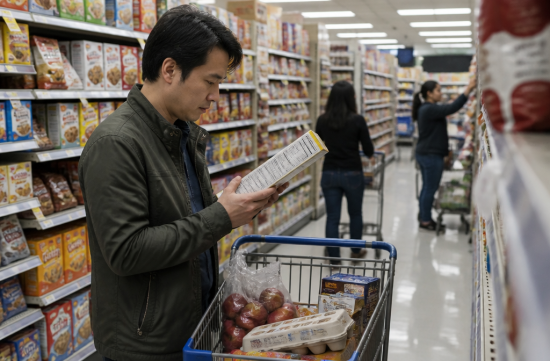
Last weekend, while pushing my cart at the grocery store, I suddenly stopped in front of the checkout. Looking at what I had, I noticed that almost everything was in bags or boxes: cereal, frozen pizza, granola bars, soda, and bread.
The ultra-processed foods that are frequently mentioned in the news these days refer to exactly this type of product. So, I decided to take a closer look.
First, let's look at the numbers. According to data released by the National Center for Health Statistics under the CDC in August 2025, from August 2021 to August 2023, American adults obtained 53.0% of their daily calories from ultra-processed foods.
For children aged 1 to 18, the percentage was even higher at 61.9%. Among those aged 6 to 11, it rose to 64.8%.
Honestly, I was a bit shocked by these numbers. It means that more than half of what we eat consists of foods combined in factories.
When looking at income levels, the highest income group among adults had a lower percentage at 50.4% compared to other groups. In contrast, children showed similar percentages regardless of income.
On the bright side, there is a trend. The percentage for adults decreased from 56.0% in 2017-2018 to 53.0%, and for children, it dropped from 65.6% to 61.9%.
So, what exactly are ultra-processed foods? The CDC data uses a classification system called NOVA, which refers to industrially processed foods that contain additives not commonly used at home. Examples include colorings and emulsifiers.
One thing to note is that there is currently no official definition from the U.S. government.
The FDA and USDA began gathering public input in July 2025, and they announced that a definition proposal would be submitted to the Office of Management and Budget by August 2026 for final review. However, as of the time of writing this article, the details have not been made public.
The new dietary guidelines released in January 2026 also recommend reducing highly processed foods and increasing natural foods, but they do not specifically define ultra-processed foods.
How harmful are they to health? A comprehensive analysis published in BMJ in February 2024 reviewed 45 existing meta-analyses and reported an association between ultra-processed food consumption and 32 health indicators.
The items considered to have the strongest evidence included deaths from cardiovascular diseases, type 2 diabetes, and anxiety.
However, since this is a collection of observational studies, we cannot definitively say that these foods are the cause. The researchers also noted that the level of evidence varies for each item. It's best to view this as data to guide your choices rather than something to fear.
So, what should you look for when shopping? Here are a few criteria I actually use.
First is the ingredient list. U.S. food labels list ingredients in order of weight. If the first two or three ingredients are sugar, syrup, or refined flour, I put it back.
Second, read the names of the ingredients. If there are words that aren't in my kitchen, it's likely ultra-processed. These include emulsifiers, artificial flavors, and color numbers.
Third, check the added sugars on the nutrition label. According to FDA guidelines, the daily limit for added sugars is 50g for a 2000-calorie diet. It's common for one beverage to contain half of that amount.
Fourth, consider the layout of the store. Vegetables, meat, eggs, and milk are usually located around the edges, while the center aisles tend to have more boxes and bags. Just getting into the habit of filling your cart from the edges can make a significant difference.
According to CDC data, the most significant source of calories from ultra-processed foods for adults was sandwiches, including burgers, at 8.6%. Following that were bread and snacks at 5.2%, and sugary beverages at 4.4%.
So, there's no need to try to change everything at once. Just reducing these three items can have a big impact. For example, swapping soda for sparkling water or replacing store-bought muffins with fruit.
If you're in a Korean household, there's an advantage. Foods made directly from raw ingredients, like rice, vegetables, soup, and grilled dishes, are typically the center of the table.
However, instant noodles, ham, fish cakes, and store-bought sauces have also made their way into our meals. It's more realistic to limit these rather than cut them out entirely.
And there's no reason to avoid processed products with simple ingredients, like frozen vegetables or canned beans. They can actually be quite helpful on busy weekdays.
Personally, I don't plan to wait for the government to provide a definition. Whether or not regulations come out, I'm responsible for what goes into my shopping cart.
It only takes a few minutes a day to read labels. There are plenty of options in the market, and ultimately, the choice is up to the consumer.
If you have any conditions like diabetes or hypertension, or if you plan to make significant changes to your diet, consult with your doctor or pharmacist first. There may be interactions with medications you are taking.
This week, try just one thing. Before putting something in your cart, read the first three lines of the ingredient label. You'll likely notice more than you expect.
 CleoPartner
 SodaExplorer








 The Emperor Must Grow |

 squidogame |

 daddyyo |

 Top Beaches |

 Solo Yolo |
 Childbirth Drabble Blog |


 tarvion |

 velion |

 ssome |
 skykong |
 Shining Our Own World |
 gardener 007 |
 golfmaster |
 Nanana Nanana Nanana |
 Who's watching? |
 endone |
 RockStar |
 Casa Mia |
 You Only Live Once |
 Hardworking CPA |
 Joyce 77 |
 Runner Kim |
 My Town My Way Blog |
 My Miami Stories |
 Entip |
 Tony Park |
 Jean Claude Bundang Blog |
 DJ DC BLOG |