
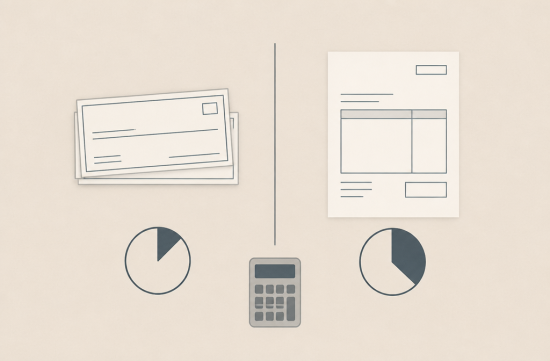
Recently, a junior colleague who transitioned to freelancing mentioned something interesting after their first quarter. They said that although their contracted hourly rate was higher than what they used to earn annually divided by hours, the actual money left in their bank account had significantly decreased.
On the surface, it seems odd, but the answer always lies in the tax structure.
If you are employed under a W-2, only 7.65% of your salary is withheld for Social Security and Medicare combined. The other 7.65% is covered by the employer, meaning you only bear half the burden.
However, working under a 1099 changes everything. Without a company, there's no one to cover that half, and ultimately, you have to shoulder the full 15.3% self-employment tax.
This 15.3% is not calculated on your total income but rather on 92.35% of it. Of that, the 12.4% for Social Security only applies up to $184,500 as of 2026, while the 2.9% for Medicare has no income cap.
In simple terms, whether freelancers earn little or a lot, the Medicare portion continues to apply. As income increases, this structure becomes more pronounced.
What's even more confusing than the tax rate difference is the method of withholding. With a W-2, the employer automatically withholds and sends the taxes to the IRS each month, but with a 1099, you must calculate and pay estimated taxes yourself four times a year: in April, June, September, and the following January.
If you miss this and spend all the incoming money as living expenses, you'll find yourself facing a hefty tax bill and penalties when you file the following year. I've seen many freelancers get caught in this trap during their first year.
On a positive note, there's some relief. With the tax law changes in 2025, the QBI deduction has been made permanent, allowing you to deduct 20% of your business income reported on a 1099 from your taxable income.
As of 2026, if your taxable income is below $201,750 for singles or $403,500 for married couples filing jointly, you can fully benefit from this 20% deduction without any significant restrictions. A new provision also allows for a minimum deduction of $400 if your net QBI exceeds $1,000.
However, it's important not to get confused. This deduction only reduces your income tax; the 15.3% self-employment tax remains unchanged. There is a separate item that recognizes half of the self-employment tax as an income deduction, but this does not reduce the tax itself, only the income tax calculation.
Taxes aren't the only difference. W-2 employees receive benefits like health insurance, 401k matching, paid leave, and unemployment insurance from their employers, while 1099 workers must prepare and price all of these themselves.
Ultimately, the 7.65 percentage points that the company used to cover are now fully borne by the freelancer. Knowing this and accepting it is entirely different from being unaware and facing it.
Personally, I find this structure lacking. As more people work in the gig economy, the social safety net still adheres to the W-2 framework, so I believe there needs to be more discussion about portable benefits that allow individuals to carry health insurance and retirement accounts regardless of their employment status.
As a practical tip, when transitioning to a 1099, you should charge at least 15 to 20 percent more than your previous hourly rate to avoid losses. Additionally, I recommend setting aside 25 to 30 percent of incoming funds into a separate account specifically for taxes.
If you choose 1099 to work freely, there's no reason to discourage you. However, I would advise you to run the numbers through a calculator before making that decision.
 TOUCHME



 moname |
 mapsina |
 Mr. Largo |
 Victory 1988 |
 Infinite Style |
 digital |
 kingdom |
 harvest |
 Flame Curry Hot Noodle Guide |
 Seattle - Emerald City |
  Springs Korea |
  nixon |
  mini hometown |
  Gleeee |
  MacMorningBlog |
  ASURA |
  Elastico |
  shaket |
  vionoo |
  chocolate |
  Whisper |
  Star Voyager |
  InDiGo |
  Rocky Mountains |
  Whoever It Is, I Don't Know |
  Why Not Me |
  Plastic Rose |
  Rice Shop Uncle BLOG |
  Gook Rule |