
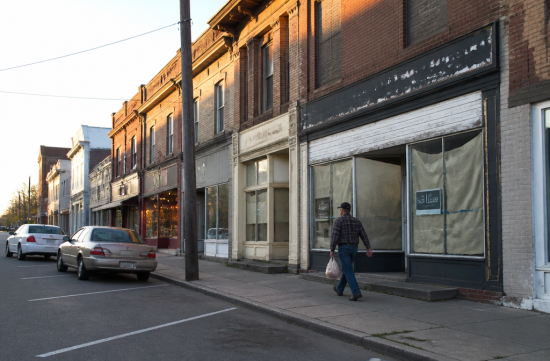
Not long ago, while on a road trip, I took a shortcut suggested by my navigation system. I ended up passing through a small town, and I noticed that half of the shops on Main Street were shuttered.
There was one bank, one pharmacy, and just the sign of a theater that seemed to have closed long ago. That scene stuck in my mind for days.
There's a unique atmosphere in these small towns. When you walk into a restaurant, the staff remembers your face, and a customer at the next table might strike up a conversation about the weather.
Thinking about how that warmth is fading made me feel even sadder. Then I suddenly wondered: when did these small towns in America start to empty out, and why?
I found out that between 2010 and 2020, the population in rural areas of the U.S. recorded its first decline. Out of a total population of 46 million, 289,000 people left, marking a decrease of 0.6 percent, which was the first decline since statistics began being recorded.
During the same period, more than half of all counties in the U.S. saw a population decrease, and the people living in those counties accounted for a quarter of the entire U.S. population, so it was definitely not just someone else's problem.
Moreover, the percentage of rural counties that experienced population growth dropped from 53.2 percent to 33.1 percent over the past decade. Where it used to be more than half, now only one in three is growing.
By state, West Virginia, Mississippi, and Illinois have seen particularly severe declines, with West Virginia experiencing a 3.2 percent drop in its rural population.
Looking into the causes, I found that 510,000 people had moved away, while only 221,000 were born. The rate at which people are leaving is outpacing births.
When young people leave for college or jobs in the city, the next step is often similar. Hospitals and schools start to close one by one, and eventually, the remaining residents pack up and leave as well.
However, it was fascinating to discover that some towns are coming back to life. I was curious about what made them different, so I did some more research.
Through the Main Street America program aimed at revitalizing downtown areas, $5.68 billion was reinvested in local communities in just 2023. As a result, 6,630 new shops opened, creating 35,162 new jobs, which is no small feat.
It was also impressive to learn that 10,556 neglected buildings were renovated and put back into use.
In a port town in Washington, residents pooled their money to create an investment fund to lend to small businesses. Thanks to that fund, small shops that had difficulty obtaining bank loans were able to open and survive.
In a Tennessee city that was sinking along with its manufacturing industry, the city decided to lay down a high-speed fiber optic network. That choice transformed the once-declining industrial town into a hub for startups and tech talent.
The economic impact of that fiber optic network has reached $5.3 billion over 15 years, with over 10,000 new jobs created.
Experts commonly point out that it's not about the size of the town. What matters is how actively the town chooses to support housing, small businesses, public spaces, and leadership.
When you think about it, the reasons people leave and the reasons they come back seem to be quite similar. It all comes down to whether there's at least one reason for people to want to settle down and live there.
Every time I read stories like this, I feel that whether it's government support or the voluntary efforts of residents, one alone is not enough. Both need to work together for a town to truly come back to life.
The next time I pass through such a town, I think I'll make a point to stop by a café and at least buy a cup of coffee instead of just passing through.
 GlamourEditor


 Victory 1988 |
 Panorama Kstar |
 Giant Squid and Sweet Potato Soup |
 Lol Life |
 lavender |
 eatontown blog |
 quiet river |
 Uptown |

 USA Life Story |
  vionoo |
  chocolate |
  Whisper |
  Star Voyager |
  InDiGo |
  Rocky Mountains |
  Whoever It Is, I Don't Know |
  Why Not Me |
  Plastic Rose |
  Rice Shop Uncle BLOG |
  Gook Rule |
  Rowland Mama |
  Coco and Lulu |
  Baguette Blog |
  washington mom |
  yorvik12 |
  solvix18 |
  HVAC will prosper |
  mortrix |