
Recently, I tried to start my car in the morning, but the dashboard lights were flickering, and the engine wouldn't start.
The battery was completely dead, and I had to call for roadside assistance to get a jump start before I could finally make it to the repair shop.
There, I received a quote for a battery replacement, and the bill was quite hefty when you included the parts and labor. I started to wonder if I could just change it myself.
In fact, there had been signs for a few days. The cranking sound when starting the car was slower than usual, and the headlights seemed a bit dim, but I had ignored those warnings.
Before changing the battery, many parts stores or repair shops offer free checks on the battery and alternator, so it's a good idea to confirm whether the battery is really the issue before blindly replacing it.
According to RepairPal, the average cost for a car battery replacement ranges from $456 to $493. Of this, the parts cost is between $394 and $403, while labor accounts for about $61 to $90.
However, if you buy the battery separately, the story changes completely. Regular lead-acid batteries sold at parts stores like AutoZone or O'Reilly range from $90 to $200, while premium batteries like AGM can cost between $150 and $300.
If you take your car to a shop, the total cost including labor can be in the high $400s, but if you buy the battery and install it yourself, you could end up spending less than half that amount.
Moreover, many stores like AutoZone, O'Reilly, and Advance Auto Parts offer free installation when you purchase a battery from them. This means you could save the labor cost of $25 to $80 that independent shops would charge.
However, this free installation isn't always available. If the battery is in a difficult location or requires removing other parts to access, the store may refuse to install it.
The actual work can take anywhere from 30 minutes to 2 hours, depending on the vehicle, and considering the time spent waiting for a shop appointment, doing it yourself might actually be quicker.
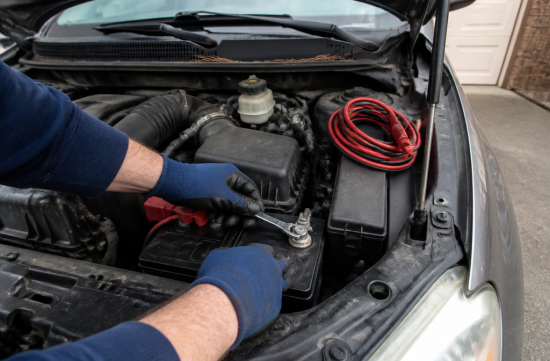
The process of changing the battery is simpler than you might think. First, you need to disconnect the negative terminal, then the positive terminal, and when installing the new battery, connect the positive terminal first.
At this point, you can't just buy any battery; you need to choose one that matches the group size and cold cranking amp rating specified in your vehicle's manual to ensure proper starting performance.
It's a straightforward task that only requires a wrench and gloves, so it feels a bit wasteful to pay labor costs just for that.
However, batteries contain sulfuric acid, and hydrogen gas can be released during charging, so you must avoid sparks or flames. The high-voltage batteries in hybrids or electric vehicles are a completely different matter and should not be handled in the same way.
When purchasing a new battery, there's often a core charge, but you can get back about $15 to $25 if you return your old battery, and warranty periods vary by brand, ranging from 1 to 4 years.
According to AAA, requests for roadside assistance due to battery failures increase by 85% on days when temperatures drop significantly. If you live in a cold area, it's wise to check your battery's condition ahead of winter.
Some newer vehicles may require a reset or registration process after changing the battery, so for those cars, it's more convenient to have it done at a store that offers free installation rather than attempting it yourself.
If it were me, I would change the battery myself on an older, simpler car, and for newer, more complex vehicles, I would opt to have it installed for free, even if it feels like a waste of labor costs.
 SmileKing


 Idaho's Sumi's House |
 holy cheese |
 Michigan Enthusiast |
 Anna Life |
 JESIKYEOALBA BLOG |
 marydock |
 crumb |


 rosem |
  Star Voyager |
  InDiGo |
  Rocky Mountains |
  Whoever It Is, I Don't Know |
  Why Not Me |
  Plastic Rose |
  Rice Shop Uncle BLOG |
  Victory 1988 |
  Gook Rule |
  Rowland Mama |
  Coco and Lulu |
  Baguette Blog |
  washington mom |
  yorvik12 |
  HVAC will prosper |
  mortrix |
  Panorama Kstar |
  MAX009 BLOG |
  K-POP TV News |
  My Beloved Hometown Hwagae Market |