
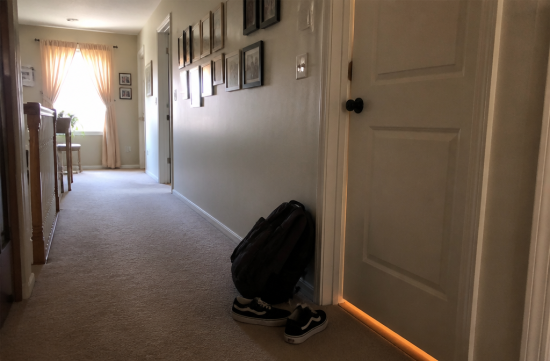
In American movies or sitcoms, there's often a scene where a teenager's door has a big sign saying "Knock Before Entering." The room is depicted as a space decorated entirely to their taste, a place that even parents cannot enter without permission.
In America today, it's so common for children to have their own rooms as they grow up that the fact this tradition is not very old feels somewhat strange.
However, looking at the actual history, the story is a bit different. It has been less than 100 years since it became common for children in America to have their own rooms.
According to data from the 1930 White House Child Health Committee, only 32.7 percent of teenagers had their own rooms at that time.
The majority of children shared rooms with siblings or sometimes even slept in the same room as their parents.
As recently as the early 20th century, it was common for immigrant families in big cities to live in cramped homes with one or two rooms, often sharing space with multiple generations.
In the early 19th century, some middle-class families in cities attempted to provide separate rooms for their children, but this was mainly the case for wealthier households.
Most families at that time often took in boarders or had live-in housekeepers, leaving no room to spare.
The trend completely changed after World War II.
Thanks to the G.I. Bill established in 1944, returning soldiers were able to buy homes at low interest rates, leading to a boom in building spacious houses in the suburbs.
A symbol of this period is the large housing developments like Levittown near New York, where thousands of similar homes were built at once, and standard houses with three or four bedrooms became the new norm for middle-class families.
As homes became larger, siblings naturally had the opportunity to have their own rooms.
The decrease in family size also played a role. With fewer children, there were naturally fewer rooms to share in a household.
The practice of taking in boarders or having live-in housekeepers gradually disappeared in the 20th century.
By 1964, the percentage of teenagers with their own rooms had risen to 65 percent, and by 1998, it reached 82 percent.
In just over 60 years, what was once a privilege for a few became a standard for the majority.
Advice from parenting experts also contributed to this change. The idea that children need their own space, separate from siblings, to grow up psychologically healthy began to spread around this time.
There's even a historian who compiled this change into a book. Jason Reed wrote a book titled "Get Out of My Room," highlighting how locking the door has become a symbol of American culture for teenagers.
During the Cold War, teenagers began decorating their own rooms with money earned from allowances or part-time jobs. By putting up posters and changing furniture, their rooms became spaces that reflected their identities.
Looking back, the era when extended families shared rooms under one roof was not unique to America. It was similar in any place where people lived, and having a separate room for each child is, in fact, a much more exceptional situation in the context of human history.
Ultimately, this change reflects a shift in values regarding whether to view the family as a single community or as a collection of individuals.
Personally, as I reflect on this trend, I feel a strange sense of ambivalence. While having one's own space certainly helps foster a child's independence, I wonder if it has also diluted the closeness of families who used to gather in one room.
The current scene, where parents and children maintain their own spaces separated by a door, might be seen as a result of American individualism permeating even the structure of homes.
Still, I believe that every child should have at least a small space they can call their own. However, I hope that this door does not become a measure of distance from family.
 PinkRabbit




 Victory 1988 |
 Panorama Kstar |
 Giant Squid and Sweet Potato Soup |
 Lol Life |
 lavender |
 Dragon Lee |

 BOL SA RAM |
 US Home Buying Information Home Insurance |
 total solution |
  Why Not Me |
  Plastic Rose |
  Rice Shop Uncle BLOG |
  Gook Rule |
  Rowland Mama |
  Coco and Lulu |
  Baguette Blog |
  washington mom |
  yorvik12 |
  HVAC will prosper |
  mortrix |
  MAX009 BLOG |
  K-POP TV News |
  My Beloved Hometown Hwagae Market |
  Tart Tart |
  Min's blog |
  Tora Tora |
  pixel77 |