
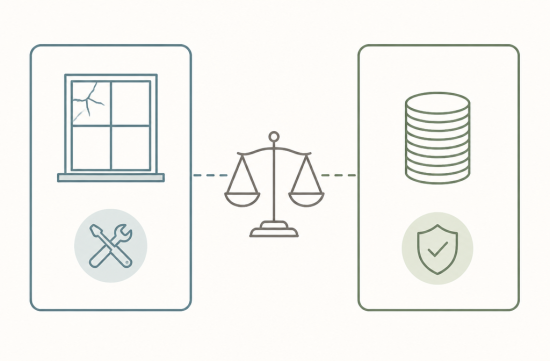
When water leaks from the roof or a window breaks due to strong winds, the first thought is often to call the insurance company. However, the key point is that before making that call, you should first crunch some numbers.
To understand this, you need to know about deductibles. A deductible is the amount the homeowner must pay before the insurance company covers the costs, typically ranging from $500 to $5,000, with many policies set at $1,000 or $2,500.
In areas prone to hail damage, some insurance products set the deductible as a percentage of the home's insured value, ranging from 1% to 2%. This means that for a home insured for $400,000, the deductible could be between $4,000 and $8,000.
As of 2025, the average cost to replace a roof is reported to be $9,522, with actual costs often falling between $5,868 and $13,215. For a few broken windows, the costs are usually much lower than this.
This leads to a situation where the math doesn't add up. If the repair cost is $300 but the deductible is $2,000, the insurance company won't pay anything, leaving only a record of the claim being filed.
This record is known as the CLUE report. This database, called the Comprehensive Loss Underwriting Exchange, contains all claim history for the past seven years, and it follows the property address, not the individual.
This means that when selling the house, this record can affect the insurance premiums for the next owner. A claim that didn't result in any payout can hold you back for years.
The increase in insurance premiums can also be significant. A single claim can raise premiums by an average of 18% to 28%, and filing a second claim within five years can increase it by as much as 49%.
There are reports indicating that homes with two claims can see annual insurance premiums rise to $4,418 based on a $250,000 home, which makes it clear that small claims should be approached with caution.
Of course, there are exceptions. Damage caused by widespread natural disasters like hurricanes, major hailstorms, or tornadoes is often protected from increasing premiums due to a single claim.
On the other hand, damage from personal negligence or natural wear and tear on an old roof may not receive such protection. The age of the roof itself is also a separate issue to consider when filing a claim.
When a roof reaches around 15 years old, many insurance companies start requiring a professional inspection before renewal. Once it surpasses 20 years, the compensation often shifts from replacement cost to actual cash value, meaning it will only cover the depreciated amount.
Some insurance companies may even refuse to renew coverage if a roof is over 25 years old and fails inspection, so it's advisable to check the age of your roof before considering a claim.
The risk of being denied renewal by the insurance company should not be overlooked. If claims are repeated in a short period, the insurance company may decide there's no reason to continue covering that home, and it can lead to actual non-renewal.
So, here's what I would do. I would first get estimates and compare them to the deductible, and if the difference isn't significant, I would just pay for it out of pocket and not file a claim at all.
It's also important to be cautious when consulting with the insurance company. In some states, simply inquiring without filing a claim can still leave a record, so it's wise to check the insurance company's policy before making that call.
If you decide to file a claim, the order of operations is important. Before signing any contracts, get estimates from at least two or three places, and also keep estimates from contractors you choose yourself, as this can be advantageous during negotiations later.
Ultimately, repairing a roof or window is not just about a few hundred dollars; it's a decision that can impact your insurance premiums and renewal for years to come. Don't rush to pick up the phone; take your time to carefully consider the numbers before making a decision.
 ChocoTime


 Idaho's Sumi's House |
 holy cheese |
 Michigan Enthusiast |
 Anna Life |
 JESIKYEOALBA BLOG |
 Hardworking Running Bobby Kim |
 Roman Pan |
 Raymond K. |

 InDiGo |
  Rocky Mountains |
  Whoever It Is, I Don't Know |
  Why Not Me |
  Plastic Rose |
  Rice Shop Uncle BLOG |
  Victory 1988 |
  Gook Rule |
  Rowland Mama |
  Coco and Lulu |
  Baguette Blog |
  washington mom |
  yorvik12 |
  HVAC will prosper |
  mortrix |
  Panorama Kstar |
  MAX009 BLOG |
  K-POP TV News |
  My Beloved Hometown Hwagae Market |
  Tart Tart |