
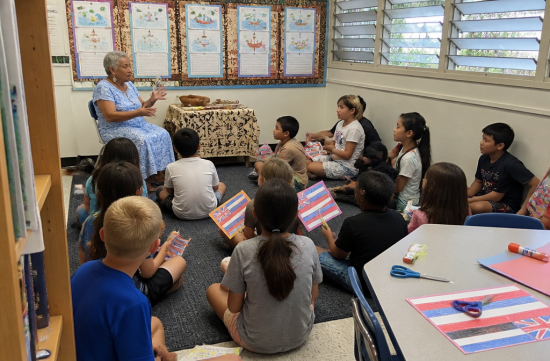
In November, I saw a local child walking by with a paper flag made at school. It was a Hawaiian flag with a pattern of the British flag in the corner. When I asked, they said it was for this month's lessons.
November is federally recognized as Native American Heritage Month. While schools on the mainland focus on stories of American Indian tribes, Hawaiian schools take a slightly different approach. Today, I will outline those differences.
First, let's look at the origins. In 1990, Congress passed a joint resolution, and President George H.W. Bush signed it, making November the first national commemorative month.
Interestingly, the person who introduced this resolution was Senator Daniel Inouye from Hawaii. American Samoa's Eni Faleomavaega was also a representative in the House.
Before that, there was only a week-long commemorative period. In 1976, President Ford designated a week in October, and in 1989, it was a week in early December.
The reason for choosing November is also stated in the resolution. It explains that this is a time when Native peoples celebrate and give thanks after the harvest. The overlap with Thanksgiving is not coincidental.
The 1990 resolution was not a law that automatically renewed each year. However, since 1994, November has been declared a commemorative month annually.
So, what do Hawaiian schools teach? This is where the core of the matter lies. Hawaii's education is embedded in the state constitution.
In 1978, Article 10, Section 4 was added during the constitutional convention, and it was confirmed by a public vote that November. It states that public schools must provide programs teaching Hawaiian language, culture, and history.
To implement this provision, the Hawaiian Studies program was created in 1980. The same provision also includes a statement encouraging the active use of community expertise.
As a result, elementary schools have a program where kūpuna, or elder instructors, come into classrooms on a part-time basis. They share stories about songs, chants, and the origins of place names.
In terms of grade levels, 4th, 7th, and 9th grades typically cover Hawaiian history. However, the specifics can vary by school, so it's best to ask the homeroom teacher for accurate information.
In June 2015, the Board of Education approved Policy E-3, Na Hopena A'o. It's abbreviated as HA, which outlines six outcomes to cultivate in all students.
These include attitudes of pride and respect for Hawaii, as well as physical and mental health. Rather than being a subject, it aims to integrate these principles into the overall school experience.
In November classes, there is a particular day that Hawaiian children encounter frequently. November 28th is La Kuokoa, Hawaii Independence Day.
On this day in 1843, Britain and France officially recognized the Hawaiian Kingdom as an independent nation. After the monarchy fell in 1893, the commemoration ceased but has recently been revived.
In 2024, a resolution will be introduced in the state House urging the Department of Education to include La Kuokoa lessons. The Department has also uploaded related materials to the curriculum resource site.
However, it is not a mandatory class for all schools in the state. While materials are provided, how to teach them is at the discretion of the teachers and schools. If a child's school made flags, it means that school emphasized that topic.
Private schools are even more proactive. Kamehameha Schools has engaged in activities like making commemorative t-shirts and has collaborated with the University of Hawaii at Manoa for events.
Stories from the mainland are also included. In Thanksgiving units, there are often stories about the Wampanoag tribe, and some classes use teaching materials from the Smithsonian National Museum of the American Indian.
What parents can do at home is simple. First, read through the activity sheets that your child brings home together. Second, look up any unfamiliar Hawaiian words together.
Third, take them to Iolani Palace or the Bishop Museum over the weekend. Connecting the stories of the kingdom learned in class to actual buildings helps with long-term memory.
Fourth, asking local elders or neighbors about the meanings of place names is also beneficial. Most Hawaiian place names relate to water, wind, or geography, which kids find interesting.
While fishing, I naturally memorized the Hawaiian names attached to various points. Once I understood the meanings, it made sense why those waters were named as they are.
One point of caution: the issues of the monarchy's overthrow and annexation are still contentious topics. If your child shares what they learned in class, it's best to listen fully before making any judgments.
From the perspective of immigrant families, this class can be seen as an opportunity. It is a time for our children to learn how to respect others' roots while also having their own.
If you receive information about related events in this month's school newsletter or from the homeroom teacher's email, don't just overlook it. The dates for events vary by school, typically around the 28th.
In summary, the federal commemorative month is just a starting point, and the true focus of Hawaiian schools is the education rooted in the constitution and La Kuokoa.
Ultimately, asking your child once more at home is the answer. Try asking them at the dinner table what they learned at school today.
 NerdAlert
 DreamStone91







 Augusta 90 |

 Pointy |

 rissa |

 Gomo Nim |

 lattepop |

 HAWAII Korean Church News |
 Hawaiian Soft Tofu HASOON |
 cococo now |

 Hawaii Tourist Information |

 TEX MEX STAR |
 Shining Our Own World |
 Raymond K. |
 gravity |
 714 Success Era Real Estate |
 Investment Beginner Company Information Encyclopedia |
 musicque |
 The Gelaton |
 ovelion |
 Chicagonian |
 Freedom Yea |
 AZ Road Master |
 glenix39 |
 Something is popping in the situation |
 orvella |
 vella |
 comets |
 Banana |
 Yes Dorian |
 Minnesota Sonata N |
 zentar |