

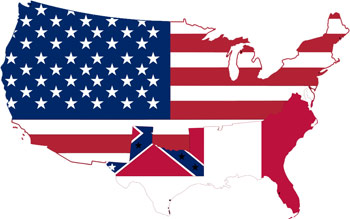
Looking at the landscape of American politics, it is truly interesting that the party support base has flipped several times since the Civil War (1861-1865). Originally, the structure of "Democrats = South, Republicans = North" lasted for over 100 years, but a significant turning point occurred in the mid to late 20th century, leading to the current understanding of "Red States (Republicans), Blue States (Democrats)."
Right after the Civil War, the Republican Party was dominant. They championed the abolition of slavery and led the Union to victory in the war, thus holding a national advantage for a time, not just in the North. Conversely, the Southern Democratic forces were significantly weakened by their defeat in the war. However, after the Reconstruction ended in 1877 and federal troops withdrew, Southern white Democrats began to regain power. By enacting laws that effectively restricted Black voting rights, the South became a stronghold for the Democrats, aptly named the "Solid South."
Entering the 20th century, the Democrats expanded their national support base through Roosevelt's New Deal policies. Workers, farmers, and minority groups supported the Democrats, and during this period, support for the Democrats in the South remained strong. However, the issue was race. As the Civil Rights Movement gained momentum in the 1940s to 60s, and the Democrats began to support it, Southern white conservatives, known as 'Dixiecrats,' strongly opposed this shift. Ultimately, in the 1960s, as the Democrats led the Civil Rights Act (1964) and the Voting Rights Act (1965), a mass exodus of Southern whites began.
The Republicans did not miss this opportunity. This was the 'Southern Strategy.' Instead of overt racism, they absorbed Southern white conservatives by promoting the slogan of "law and order," and over the Nixon and Reagan eras, the South gradually transformed into a Republican stronghold. As a result, the South, which was once a bastion of the Democrats, has now become a "Red State" dominated by the Republicans.
Conversely, the Democrats solidified their support in the Northeast, West Coast, and major cities. Voters from minority groups, the youth, and those with progressive values became the backbone of the expanding "Blue States." Of course, the landscape is not fixed even now. Some Southern states like Virginia and Georgia have become battlegrounds between the Democrats and Republicans due to population influx and urbanization, while in the Rust Belt, Republicans have targeted the working class, shaking the Democrats' traditional base.
Ultimately, the era when the Democrats dominated the South right after the Civil War can be seen as having completely flipped through the Civil Rights Movement of the 1960s and the strategies of the Republicans. Even now, variables such as population movement, generational change, immigration, and urbanization continue to act, causing the support landscape to change fluidly. This is what makes American politics so fascinating.







 Magic Cabbage School of Martial Arts |
 Vacation on Hawaii |
 morvex37 |
 Ari Songhan American Immigration Life |
 Bearded Strawberry Smoothie |
 Chino Min |


 DREAM BIG |
 Information on All Regions of the United States |
  laro90 |
  MEDBIO American Doctor Blog |
  SWAT TEAM BLK |
  frostbite |
  330 Forever My Love |
  El Dorado |
  dralix58 |
  Gorama Round |
  Skydiving |
  dreamport |
  Yellow Snowman |
  Toaster Pizza Magic Show |
  velvetnom |
  Anytime Journey |
  Mrs. Duluth |
  jaxter |
  Atlanta Mama |
  Baguette Blog |
  Tan Sol |