
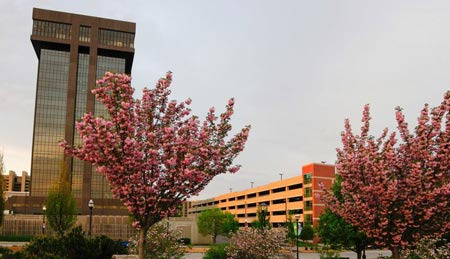
The climate of Springfield, Missouri, is classified as a humid subtropical/continental transition. Winters are cold, summers are hot and humid, while spring and fall are relatively mild and pleasant. The climatic characteristics of this area are due to its location where the cold continental air mass from the north collides with the warm, moist air mass from the Gulf of Mexico, resulting in significant weather changes and a propensity for severe storms.
Looking at the average temperatures by season, in winter (December to February), the average low temperature ranges from -3 to 0 degrees Celsius, while the average high temperature is about 5 to 8 degrees. January is the coldest month with an average temperature of about 1 to 2 degrees Celsius, and extreme cold can drop below -10 degrees, although it does not last long. Spring (March to May) is a season of rapid weather changes, where March can still see frost and late snow, but by April and May, the average temperature rises to 13 to 22 degrees, making it a good time for outdoor activities. However, there is a high risk of tornadoes in spring, so caution is advised. In summer (June to August), the average high temperature reaches 32 to 35 degrees, and with high humidity, the perceived temperature is even higher. August is the hottest and driest month, with occasional days exceeding 100 degrees Fahrenheit (about 38 degrees Celsius). Fall (September to November) is the most pleasant season in Springfield, with an average temperature of about 15 to 20 degrees in October, making it the peak time for hiking and outdoor activities with the Ozarks' fall foliage at its best.
In terms of precipitation, Springfield records about 45 inches (approximately 1,143 mm) of rainfall annually, which is slightly above the national average. Rainfall is relatively evenly distributed throughout the year, but tends to be higher in spring (April to May) and early winter (November to December). Spring precipitation often comes in the form of strong storms accompanied by thunder and lightning, and severe thunderstorm warnings, including tornadoes, are frequently issued in spring and early summer. Springfield is located on the eastern edge of the United States' 'Tornado Alley,' so residents are familiar with weather alert systems and storm evacuation plans.
Regarding snowfall, Springfield receives an average of about 12 to 15 inches (approximately 30 to 38 cm) of snow annually. Compared to Seoul, South Korea (about 28 cm annually), this is similar or slightly more. In years with heavy snowfall, there can be blizzards of 6 to 10 inches at once, but due to the frequent fluctuation of temperatures above and below freezing, the cycle of snow falling and melting is common. The most concerning weather phenomena in winter are freezing rain and sleet rather than snow. Black ice on the roads is a major cause of traffic accidents, and while the city authorities are responsible for snow removal and ice control on main roads, side streets and residential roads must be managed by individuals. Overall, Springfield's climate is relatively mild compared to other Midwestern cities, with shorter and warmer winters compared to the harsh cold of Chicago or Minneapolis.
 SaladBase






 TEXAS Fishing Boat |
 Study Abroad Life Know-How Tips |
 pravix22 |
 American Hardcore Band |
 Rice Shop Uncle BLOG |
 moname |
 ramen |
  menmo |
 French fries |
  Rynex |
  Caribbean |
  Let's Be Like a Salt-like City Person |
  Belgray Miscellany |
  sweetvan |
  Augusta Univ |
  Round and Round Children's Song Kingdom |
  butter 90 |
  Lando Mao |
  Washington Denzel DJ |
  LIZ Legal Information Blog |
  vegas mom |
  Sandiego Auntie |
  Premium Gas Camp |
  Things to know |
  AUTO OK |
  aaoaa |
  Florida King |