
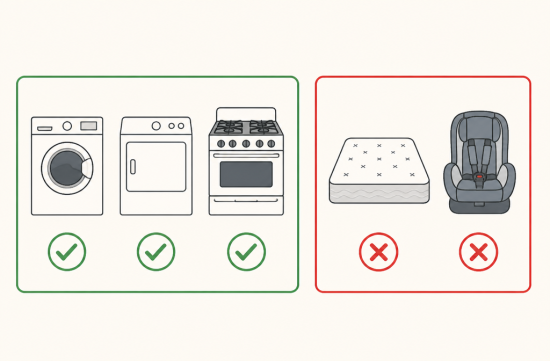
Last weekend, my friend who lives next door was excitedly bragging about buying a used washing machine at a yard sale.
However, another friend present immediately warned against buying a used mattress.
Both are secondhand, so I was curious about why one is acceptable while the other is not, and I did some digging.
It's commonly said that used appliances can be found for 30 to 50 percent less than new ones, but the results vary significantly by item.
To put it simply, there are clear distinctions between what is okay to buy and what should be avoided.
First, washing machines and dryers are generally fine to buy used as long as they are not too old and function properly.
However, washing machines often develop mold inside the drum and around the door rubber seal, so it's important to open the door, check for odors, and slightly peel back the seal to inspect inside.
For dryers, if the heating element or temperature sensor fails, drying times increase, and dust buildup can pose a fire hazard, so be sure to check the condition of the lint trap and exhaust vent.
Before buying either a washing machine or dryer, it's best to ask the seller to plug it in and run a cycle to ensure it works properly.
Stoves, whether gas or electric, surprisingly last for decades, making them a safe choice for used purchases.
As long as the burner grates and rubber seals are intact, you just need to check for deep scratches on the surface.
On the other hand, refrigerators are a bit more ambiguous.
The compressor, a key component, can be expensive to repair if it fails, so when buying used, it's wise to check if the ice maker actually produces ice.
Additionally, refrigerators made before 2000 consume between 1,000 to 1,500 kilowatt-hours annually, while today's Energy Star certified models use less than a third of that.
Even if you get a good deal on the initial purchase price, you may end up paying that difference back in your monthly electric bill, so it's crucial to consider the age of the refrigerator.
Buying from a company that specializes in refurbished appliances rather than a private seller is also a good option, as these businesses often conduct basic inspections and provide short warranties, giving you more peace of mind.
Up to this point, these items are generally safe to buy, but there are two things you should absolutely avoid.
One is a mattress.
Research shows that used mattresses can harbor an average of ten million dust mites, and due to their thickness of 25 to 35 centimeters, cleaning the surface alone doesn't reach the inside.
Moreover, if bed bugs are present, the cost for pest control can range from $500 to $2,000, making it a case where saving money can end up costing you more.
The other item to avoid is a car seat.
Car seats typically have a lifespan of 6 to 10 years from the date of manufacture, and when buying used, you have no way of knowing if it has been in an accident or is subject to a recall.
Even if it looks fine on the outside, a car seat that has absorbed an impact may have internal damage, so personally, I would never buy one used, no matter how good it appears.
When looking for used appliances or baby items, I recommend getting into the habit of checking recall histories on the CPSC official website.
Products can be recalled even 3, 5, or 10 years after they were sold, so investing a few minutes can save you money and provide peace of mind.
In summary, washing machines, dryers, and stoves can be purchased with careful inspection, but mattresses and car seats should be completely avoided, no matter how cheap they are.
 HoneyDreamer







 Idaho's Sumi's House |
 holy cheese |
 Michigan Enthusiast |
 Anna Life |
 JESIKYEOALBA BLOG |
 Real Estate |
 yenne |


 harper |
  Automation Logic User |
  MAX009 BLOG |
  K-POP TV News |
  mortrix |
  My Beloved Hometown Hwagae Market |
  yorvik12 |
  Tart Tart |
  Min's blog |
  Tora Tora |
  pixel77 |
  cuteasducks |
  Lemon Kim |
  What can make money? |
  An ant castle |
  Haha and Bomi Blog |
  glenview 89 |
  Valley Hong |
  novapixel |
  Mr. Midwest America |