

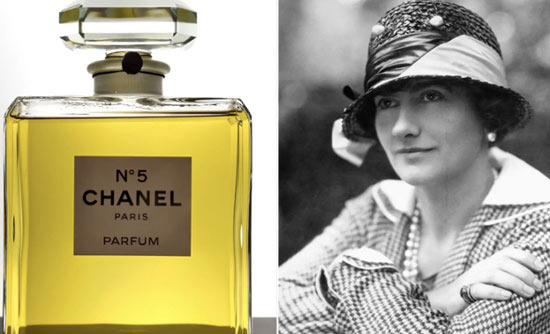
Chanel No.5 remains more of a symbol than just a perfume. Often referred to as a "classic fragrance," this perfume was, from its inception, the opposite of classic and was almost a rebellion against the times.
No.5 is not just a scent; it is a kind of revolution that carries the message that 'women can choose freely.'
In 1921, Coco Chanel decided to create a new perfume. At that time, most perfumes were natural scents made from a collection of flowers. It was common to use a single scent, like rose for rose or violet for violet, and women considered 'modest and clean floral scents' as the standard for perfumes. However, Chanel had no interest in these traditional standards. What she envisioned was a scent that 'a woman could choose according to her own taste,' which was elegant yet free. So she told perfumer Ernest Beaux, "I want to create a fragrance that is not the smell of a single flower, but the essence of a woman herself."
The resulting fragrance was No.5. The reason this perfume was shocking was that it used a large amount of the synthetic fragrance aldehyde. Synthetic fragrances were considered 'cheap' by the standards of the time, but for Chanel, they were rather futuristic materials. When No.5 appeared in a market that insisted on only natural scents, people could not immediately describe this fragrance. It was reminiscent of roses, yet also of soap; it was clean yet sensual, elegant yet bold. It encapsulated the 'complexity of women' that could not be defined by a single scent. That ambiguity was the innovation.
The bottle design was also a prime example of Chanel's minimalism. At the time, perfume bottles were adorned with elaborate decorations like jewels, but Chanel simply attached a number to a plain square bottle. True to her confident nature, even without embellishments, No.5 became a powerful brand just with its number.
Even now, the design looks sophisticated, and imagining that this bottle was displayed in the 1920s shows how groundbreaking it was. Some bought bottles that sparkled like diamonds, while others chose square glass bottles. That difference was the difference of the times.
The moment No.5 truly became an icon was when it met Hollywood. The anecdote of Marilyn Monroe saying, "I only wear Chanel No.5 when I go to bed" is already famous. It was neither an advertisement nor a sponsorship. When a reporter asked her, "What do you wear to bed?" Monroe playfully replied. In that brief moment, No.5 completed its image as the ultimate luxury item.
If perfume becomes a fashion item that one wears like clothing, then wearing that scent to sleep signifies the most intimate luxury. It is not a luxury for show purchased with money, but a luxury for oneself. This concept fits No.5 perfectly.
Since then, No.5 has remained unwavering. Even as new perfumes continue to emerge and trends shift towards fruity, woody, and spicy scents, No.5 has not changed its place. People expected dramatic changes over time, but No.5 functioned without changing. Not following trends is, in itself, evidence of having surpassed them.
Chanel No.5 is, before being an attractive perfume, an attitude. It carries the message of 'not defining women by a single scent' and the belief in 'natural yet confident choices.' It is not a scent that one quickly sprays and leaves the bathroom with, but a fragrance that subtly permeates one's very existence. Therefore, those who love No.5 feel as if they are not just choosing a scent but selecting the direction of their own taste.
No.5 has held a unique position in the perfume market for a long time. Much like the saying, "I am myself." I believe the reason Chanel No.5 will forever remain a classic is that its scent itself is a declaration of freedom for an era.





 Khan Film Blog Production |
 dermoon |
 hoosierdaddy |
 sun walker |
 Let's Be Like a Salt-like City Person |
 US 210 Kim Sangsa |
 Mental Health Psychiatrist |
 August Snowman |
 Gupabal MissKorea |
 Korean Mom |
  My NYC |
  moo moo |
  Mr Oh |
  forevergee |
  festival |
  manchester |
  constant |
  Leapfrog Move |
  vibranto |
  Tora Tora |
  yellowbutter |
  Dolly |
  US Embassy |
  NYC saladbar |
  Finding Superfoods |
  lightyear |
  song bang |
  vexomo |
  Indiana Jones |