
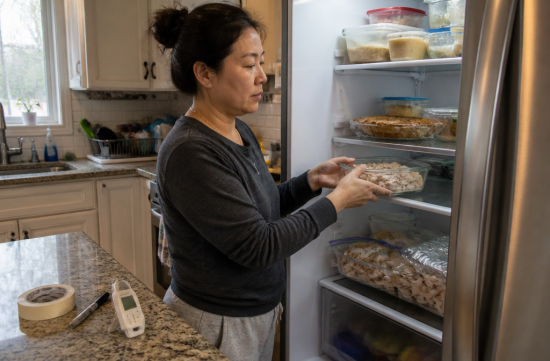
The turkey roasted on Thursday is still taking up an entire shelf in the fridge. Today is Sunday, so it's been exactly three days.
This morning, while making a turkey sandwich, I paused. I wondered if it was really okay; the smell seemed fine, but I started to doubt. Every year around this time, I have the same concerns, yet the exact guidelines always seem a bit hazy.
So, I looked up information from the USDA and FoodSafety.gov. I believe it's better to know the guidelines rather than rely on intuition.
To get straight to the point, the guideline for refrigerated leftovers is 3 to 4 days. Cooked turkey follows the same rule: 3 to 4 days. I was a bit surprised that it was shorter than I expected.
This year's Thanksgiving was on Thursday, November 26. So, that means today, Sunday, is the cutoff between Monday.
There's an important premise here: the refrigerator must maintain a temperature below 40 degrees Fahrenheit for this timeframe to be valid.
In fact, what's more important than the date is the time it takes for food to go from the table to the fridge. The USDA recommends putting food in the refrigerator within 2 hours after cooking or serving.
If the indoor temperature exceeds 90 degrees Fahrenheit, that time is reduced to 1 hour. In the South, there are days in November that can be warm during the day and then cool off, so it's worth keeping an eye on this.
The reason is the temperature range between 40 and 140 degrees Fahrenheit. In this temperature zone, bacteria can multiply rapidly, which is commonly referred to as the danger zone.
When you're enjoying dessert and chatting, 3 to 4 hours can pass quickly. Honestly, my family breaks this rule the most every year. It's almost become a tradition for the turkey to sit in the center of the table all evening.
This raises the question: if the food has been sitting out for a while, isn't it okay to reheat it? The official guideline states that food left out at room temperature for more than 2 hours should be discarded.
There's also a common misconception about storage methods. Many people think they should let food cool to room temperature before putting it in the fridge.
According to a USDA survey, 76% of participants believed this. However, the official stance is that waiting like this actually makes food more dangerous.
Instead, the key is to divide large portions to cool them quickly. A whole leftover turkey or a large pot takes too long to cool down completely. The outside may be cold, but the inside can remain lukewarm for a long time.
So, it's better to carve the turkey off the bone. The breast can be sliced, while the legs and wings can remain whole.
Gravy or soup cools much faster when divided into several shallow containers. It's better to use a few flat containers than one large one.
If you think you won't finish it within four days, freezing is the answer. At 0 degrees Fahrenheit or below, food remains safe indefinitely.
However, the freezing duration is based on taste and quality, not safety. The longer you keep it, the more moisture it loses and the flavor diminishes. So, there's really no reason to pull out turkey that's been sitting in the back of the freezer for six months.
It's recommended to eat sliced turkey within 4 months for quality. I usually portion it into meal-sized servings in zip bags and write the date on them.
When reheating, the internal temperature should reach 165 degrees Fahrenheit. I recommend using a food thermometer instead of estimating. It's not an expensive tool, and once you have it, you can use it for cooking meat repeatedly, so it pays for itself.
Gravy, soup, and sauces should be brought to a rolling boil once. Covering while reheating helps retain moisture and heat evenly throughout.
When using a microwave, it's good to stir or flip the food halfway through. It's very common for the edges to be hot while the center remains cold.
It's advised to avoid reheating in a slow cooker. The temperature rises slowly, which can keep food in the danger zone for too long.
Side dishes can be a bit complicated. Many sources indicate that pumpkin pie can be stored in the fridge for 3 to 4 days. Since it contains milk and eggs, any leftovers should be refrigerated.
On the other hand, the storage times for stuffing and cranberry sauce varied quite a bit across sources. For these, it's best to check the USDA FoodKeeper app for item-specific information.
If you're still confused, you can call the USDA Meat and Poultry Hotline. The number is 1-888-674-6854, and you can check the operating hours on their official page.
My guideline is simple: I eat Thursday's food by Monday evening, and anything left after that gets tossed without hesitation. However, around Sunday, if I see that I won't finish the leftovers, I move them straight to the freezer.
I don't trust my judgment based on smell or appearance. The bacteria that cause food poisoning often don't change the smell or taste, which is a well-known fact.
There's a saying, "When in doubt, throw it out," and it's there for a reason. It's much cheaper to throw away a few pieces of leftover turkey than to spend days feeling sick.
 CandySmile



 Atlanta Business Information |

 InJung Gu |

 Golden life |

 savannah choi |

 bravo777 |









 Mr. Midwest America |

 orvella |

 donggul donggul |

 Mr. Largo |

 Silent Sea |
 moomoon |
 silverado |
 eatontown blog |
 Then you must be spring |
 Experiences Living in America |
 looksee 78 |
 hazelnut |
 Top |
 crystalx |
 DOCTOR MED |
 Mia Flori |
 zorvik79 |
 There Are Such Things in the World |
 liquid asset |
 Banana |
 nova nova |
 Cahty Chung |
 NFL Forever |
 denvik37 |
 Choco Choco Star |