
As Thanksgiving weekend approaches, the sound of ladders being pulled out in the neighborhood begins. The moment the lights go on at the neighbor's roof, my competitive spirit ignites as well.
I can hang lights better than anyone in the neighborhood. This isn't bragging; it's just a fact, haha.
However, even I have those heart-stopping moments every year. Just one more clip at the edge of the eaves, and yet I hesitate to move the ladder and stretch out instead.
We've all been there, right? Honestly, ladder accidents often stem from those "just one more time" moments rather than major mistakes.
The CDC has a report analyzing injuries from falls while decorating for the holidays. Between 2000 and 2003, they estimated that 17,465 people were treated in emergency rooms during three holiday seasons.
Of these, 43% were due to falls from ladders. Men were twice as likely to fall and get injured compared to women.
This data is old, so the numbers may not be the same now. Still, I admit that confident guys like me need to be more careful.
So, what should we check before climbing up? First, it's not just the ladder; it's the sky and the ground.
The American Academy of Orthopaedic Surgeons (AAOS) advises against using ladders on windy days. If you know how strong the winds can be by the lakeshore, you don't need a long explanation.
According to the National Weather Service's climate report for Buffalo, the first snowfall usually occurs around mid-November. Lake-effect snow peaks in December, and many significant snowstorms happen in late November and early December.
This coincides perfectly with when we hang lights. So instead of saying, "I'll definitely do it tomorrow," it's smarter to plan for "a dry, windless day."
The ground can also be a hidden trap. AAOS advises avoiding uneven spots and muddy areas that form when the ground freezes and thaws.
Placing a ladder on a box or container because it's too short is something OSHA specifically warns against. If the ladder is too short, just borrow a longer one.
Make sure to clear snow and mud off the ladder rungs and the soles of your shoes. Slippers are obviously not acceptable; properly laced shoes or boots are the way to go.
Second, check the ladder's condition. Look for loose screws and hinges, and check if the rungs are bent or broken. If you're using an extension ladder, ensure the locking mechanism is fully engaged.
Thinking of just taping it up to get through this year? That's not a good idea. Temporary repairs can fail when you're up high.
Also, check the maximum load on the side label. This isn't just your body weight; it includes the weight of tools and lights combined.
If you've eaten Thanksgiving turkey like a champion, you need to calculate more honestly.
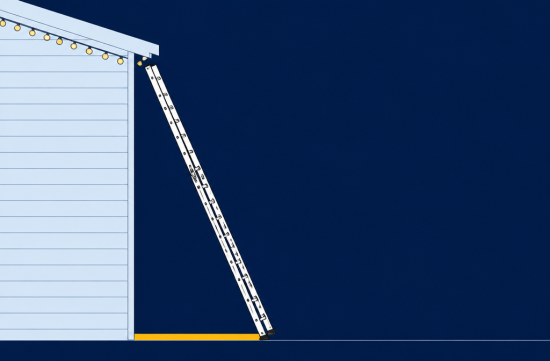
Third, consider the angle, which is crucial. OSHA's guideline is to place the base of the ladder one-fourth of its length away from the wall it leans against.
If you're using a 16-foot ladder, the base should be 4 feet away from the wall. If it's too steep, it can tip over; if it's too flat, your feet can slip.
If you're unsure about the angle, you can use the Ladder Safety app from NIOSH under the CDC. Just hold your phone up, and it will help you find the right angle with sound and visuals, and it's free. I don't understand why they don't advertise this more.
If you're planning to step onto the roof, the top of the ladder should extend at least 3 feet above the support point. Personally, I recommend designs that allow you to avoid climbing onto the roof altogether.
Fourth, there are rules for when you're up there. When climbing up or down, you should always have two hands and one foot, or two feet and one hand, on the ladder.
So carrying a bundle of lights in one arm while climbing is a no-go. I would suggest distributing the weight into a bag slung over my shoulder. The more times you go up and down, what's the harm? Just think of it as leg day.
Your belly button should never go outside the side rails of the ladder. If it looks like it might, come down and reposition; no exceptions. It's also prohibited to nudge the ladder while someone is on it.
When standing on a ladder, you shouldn't be on the top three rungs. For A-frame ladders, the highest safe position is two rungs below the top, and leaning a folded ladder against a wall is also not allowed.
Fifth, watch out for electrical wires. OSHA advises checking for overhead wires before lifting the ladder and to avoid metal ladders near power lines.
Also, test the light strings on the ground beforehand. Discard any that are frayed or pinched, check if they're rated for outdoor use, and secure them with clips instead of nails.
Finally, don't do it alone. If there's no one to watch you, it's best not to climb, and if you've had a drink or taken drowsy medication, you should take a break.
This year, I plan to showcase the best lights again. However, the best isn't the person who climbs the highest; it's the one who safely comes down and turns them on, which I think is pretty cool.
 Redwolf



 Mr. Largo |

 Darnignac |
 Banana |

 See It |










 Mr. Midwest America |
 orvella |

 donggul donggul |

 Silent Sea |
 nova nova |
 Cahty Chung |
 NFL Forever |
 denvik37 |
 Choco Choco Star |
 Entering Art Directly |
 Mini Mee |
 Exciting chichichi |
 My Circle |
 Fun Flex Life |
 dermoon |
 Starbucks Reserve Roastery Closure |
 Noodle Noodle |
 Round and Round Children's Song Kingdom |
 Exciting FM Radio |
 vexon87 |
 Helpful Life Stories |
 leaves |
 glenview 89 |