
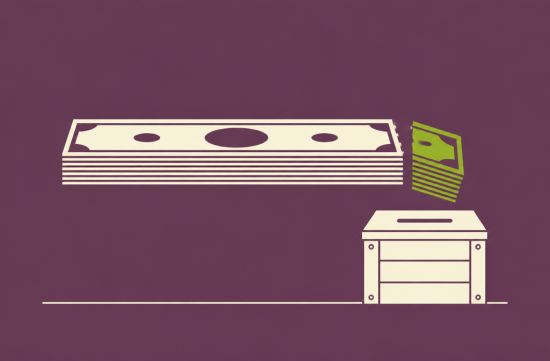
After the Thanksgiving holiday, I opened my inbox to find a stream of donation requests. Perhaps because next Tuesday is Giving Tuesday, organizations are in a frenzy.
In the past, I would have just ignored them, but this year is different. Starting in 2026, the rules for deducting donations are changing significantly.
To be honest, I have never received any tax benefits from my donations until now. I have only taken the standard deduction without itemizing.
Most people are probably in the same situation as me. The standard deduction for 2026 is $16,100 for singles and $32,200 for married couples filing jointly, so not many households have enough deductions to exceed that.
However, the One Big Beautiful Bill Act passed last summer includes a deduction for donations for standard deduction filers. This will take effect starting in the 2026 tax year.
According to the IRS, even those who do not itemize can deduct cash donations made to qualified charities up to $1,000. For married couples filing jointly, the limit is $2,000.
Let me clarify one thing. It's not that you get back $1,000; it's that $1,000 is deducted from your taxable income.
This means the actual tax reduction is based on your tax rate. If you are in the 12% bracket, a $1,000 donation would reduce your tax by $120.
For married couples, the limit is $2,000, so if they are in the 22% bracket, their tax would decrease by $440. That's about the cost of a grocery run at the end of the year.
At first, I was a bit sour. I initially thought I would be getting $1,000 back. Still, considering that I had zero benefits before, this is much better than nothing.
The conditions are quite strict. First of all, only cash donations qualify.
Cash doesn't just mean bills; it also refers to money given via checks, cards, or bank transfers. However, donations of items like clothing, furniture, or stocks do not qualify for this deduction.
Those who donated old clothes to Goodwill and received a receipt might feel disappointed about this. I also donated two winter coats last month, but that doesn't count.
Money placed in a donor-advised fund (DAF) is also excluded. Donations made to supporting organizations are not eligible either.
Any amount exceeding the limit does not carry over to the next year. Even if you donated $3,000 this year, standard deduction filers will only be recognized for $1,000, and the rest simply disappears.
Donations to churches or synagogues are usually eligible since they typically qualify as 501(c)(3) organizations. However, since eligibility can vary by organization, it's best to check the IRS website's Tax Exempt Organization Search.
You also need to keep documentation. The IRS advises keeping receipts, canceled checks, and bank records.
For donations of $250 or more made at one time, a written acknowledgment from the organization is required. That's why you shouldn't throw away the donation receipt your church gives you at the end of the year.
What about those who itemize? This group has actually become a bit disadvantaged.
Starting in 2026, itemizers can only deduct the portion of donations that exceeds 0.5% of their adjusted gross income (AGI). If the AGI is $100,000, the first $500 of donations won't be deductible.
So, if the donations for that year do not exceed 0.5% of the AGI, itemizers won't be able to deduct any donations at all. However, they cannot use the $1,000 deduction for standard deduction filers as a substitute.
A new rule has also been introduced that caps the deduction effect for high-income earners in the top 37% tax bracket at 35%. While not many people will be affected, it's good to be aware of.
For households making large donations, the strategy of bunching several years' worth of donations into one year is often discussed. This is to ensure they exceed the 0.5% threshold just once.
If you're in your parents' generation, you might also want to look into Qualified Charitable Distributions (QCD) from an IRA. If you're over 70 and a half, you can use this, and the limit for 2026 has increased to $111,000 per person.
QCDs are not deductions; they are structured to not count as income from the start, so the calculation is different. Since there are interactions with retirement income and other deductions, it varies by individual circumstances, so be sure to check with a tax professional or expert.
Timing is also important. To qualify for the 2026 deduction, donations must be made by December 31, and actual filing will occur in the spring of 2027.
This is about federal income tax. Maryland state income tax has a different calculation method, so you'll need to check separately how that works at the state level.
I plan to split my donations between the church I attend this year and the local food bank, using my card. I'll take a photo of the receipts as soon as I get them and keep them all in one folder.
Honestly, I'm not donating just to save a few dozen dollars on taxes. Still, if I can get something back while giving, there's no reason to pass that up.
Like fermented pickles, this system may seem sour at first, but once you understand it, it can be surprisingly useful. For those taking the standard deduction, make sure to keep your donation receipts this year.
 AZCowboy

 maryland park |


 strawberry |

 American Travel Cruise Information |

 norazoo |

 macaronpop |








 road98 |

 Casa Mia |

 Conflite Teacher |

 Colorado Love |
 Tainami American Travel Story |
 Top |
 crystalx |
 DOCTOR MED |
 Mia Flori |
 zorvik79 |
 There Are Such Things in the World |
 liquid asset |
 Banana |
 nova nova |
 Cahty Chung |
 NFL Forever |
 denvik37 |
 Choco Choco Star |
 Entering Art Directly |
 Mini Mee |
 Exciting chichichi |
 My Circle |
 Fun Flex Life |
 dermoon |
 Starbucks Reserve Roastery Closure |