
It's the last morning of the Thanksgiving holiday. The turkey is all gone, and all that's left is a teenager who won't get off the couch and some sandwich ingredients.
I understand sleeping in during the holidays. But this month, it's been taking 15 minutes to wake them up even on weekdays, which is starting to worry me.
Looking at the calendar, I see one reason. Daylight saving time ended on November 1, and now in this area, the sun sets just after 4 PM.
According to a report from WCAX, the earliest sunset this year is at 4:12 PM in early December. This means that by the time school is out and homework is done, it's already dark outside.
What we often hear during this time is about seasonal affective disorder, commonly known as SAD. It's easy to think of it as just feeling down, but the National Institute of Mental Health (NIMH) classifies it as a type of depression.
The key point is that it recurs with the seasons. According to NIMH, symptoms last for 4 to 5 months each year and typically begin in young adulthood.
In the winter type, there are specific signs to watch for. Excessive sleeping, cravings for carbohydrates leading to weight gain, and social withdrawal are common indicators.
Honestly, when I first read this, I couldn't help but laugh. Sleeping a lot and craving ramen while staying in the room is pretty typical behavior for most teenagers.
So, it can be hard to distinguish. Teens naturally have a delayed circadian rhythm, and their typical teenage aloofness doesn't help either.
The health information site KidsHealth outlines signs specific to teens that are a bit more concrete. Increased irritability, crying easily, and withdrawing from friends or activities are mentioned.
Difficulty concentrating and declining grades are also common signs. They may become particularly sensitive to criticism and start blaming others more often.
My criteria are, "Has there been a change compared to their usual self?" It's more concerning if a child who usually begs to go skiing every weekend suddenly finds it all too bothersome than if a child who already sleeps a lot continues to do so.
Duration is also important. Feeling down for a day or two is normal, but it's essential to observe if it lasts for several weeks.
One thing that shouldn't be confused is that NIMH specifically advises not to mistake winter-type SAD for the so-called "holiday blues" that come from year-end stress.
So, there's no need to label a few days of feeling down after the holidays as a disorder. Conversely, if they consistently feel this way around this time every year and it lifts in spring, that's a pattern worth noting.
I keep a journal. I jot down what time they went to bed and woke up, how dinner went, and whether they talked about friends.
This turns out to be surprisingly useful. It communicates much better than saying, "They've been acting a bit strange lately" when visiting the pediatrician.
What can be done at home doesn't have to be elaborate. Just taking them outside for a bit while it's still light out can help.
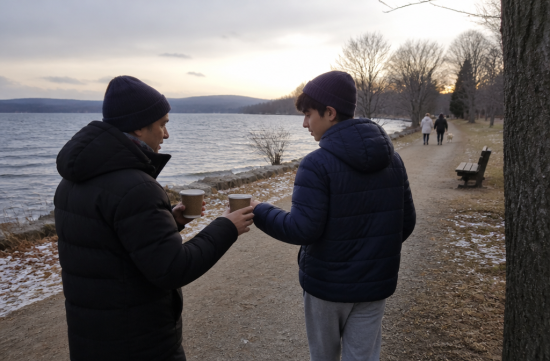
Whether it's a walk around the lake around lunchtime or a stroll to the local café on a weekend morning, it works. Surprisingly, they often come along for a hot chocolate.
I also try to keep their sleep schedule from getting too disrupted. If I let them sleep until noon on weekends, Monday mornings become a battle, so I compromise by not letting the difference in wake-up times between weekdays and weekends get too large.
I pay attention to dinner menus as well. Since cravings for carbohydrates are one of the signs of winter-type SAD, I try to prepare meals rich in meat and vegetables instead of just chips.
When it comes to conversations, I find that asking questions while driving or doing the dishes works better than a face-to-face sit-down.
However, I try not to drag things out too long at home. If symptoms persist for several weeks or school life is affected, it's best to consult a pediatrician or family doctor first.
Discussions about light therapy, counseling, or medication may come up, but what works varies from child to child. Don't jump to conclusions with self-diagnosis; always consult a doctor or pharmacist.
Having emergency numbers handy can ease anxiety in urgent situations. You can reach 988 for calls and texts, available 24/7.
The Vermont Department of Health also provides crisis text counseling by texting VT to 741741. This may be more comfortable for teens who find phone calls daunting.
In Chittenden County, there's the First Call line at the Howard Center. The number is 802-488-7777, and they offer free counseling 24/7, regardless of age.
If someone's life is in danger, don't hesitate to call 911. I want to emphasize this separately.
In our small Korean community, discussing children's mental health issues can feel a bit sensitive. Still, I believe we should treat feelings of sadness just like we would if someone had a cold and needed to see a doctor.
For dinner tonight, I think I'll make turkey rice bowls instead of chicken with the leftover turkey. I'm planning to try to convince them to go grocery shopping with me before it gets dark.
 vibecoasttraveler1982

 Joseon Dynasty Seal Enthusiasts |

 xelton52 |

 nuvex11 |


 korian87 |









 Allaston New Yorker Notebook |
 American Food Information & Calories |

 korando9 |

 Augusta 90 |

 Pointy |
 DOCTOR MED |
 Mia Flori |
 zorvik79 |
 There Are Such Things in the World |
 liquid asset |
 Banana |
 nova nova |
 Cahty Chung |
 NFL Forever |
 denvik37 |
 Choco Choco Star |
 Entering Art Directly |
 Mini Mee |
 Exciting chichichi |
 My Circle |
 Fun Flex Life |
 dermoon |
 Starbucks Reserve Roastery Closure |
 Noodle Noodle |
 Round and Round Children's Song Kingdom |