
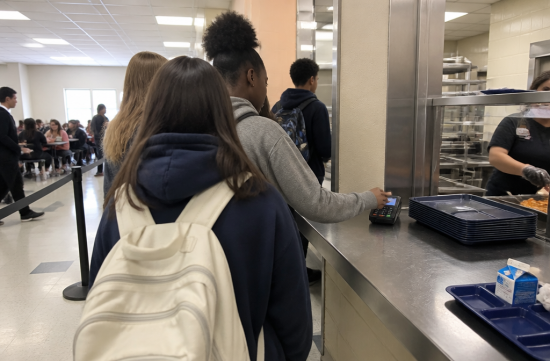
When I first heard that you have to add money to an account to eat at school in the U.S., I honestly thought, what does that even mean?
If there is a balance on the meal card, and that balance runs out, it goes into the negative. So, even an eight-year-old is essentially dealing with the concept of credit.
There is a specific term for this. It's called school meal debt.
According to a survey by the School Nutrition Association, the median amount of this debt rose from $5,495 in the fall of 2023 to $6,900 in the fall of 2024, a 25.6 percent increase. This is based on one school district, so when you add it up nationally, the scale is significant.
In the same survey, the median for the 2017-18 school year was $3,400, and for the 2014-15 school year, it was $2,000. I tend to complain when prices go up, but this is a number that has risen faster than inflation.
In fact, we have had our own noisy experiences with school meals. On August 24, 2011, Seoul held a referendum over the scope of free school meals.
The voter turnout was only 25.7 percent, failing to meet the 33.3 percent requirement for counting the votes, and the mayor resigned two days later. A single meal was enough to swing the mayor's position.
The difference is that Korea passed that debate relatively quickly. In the U.S., the same issues have been circling for nearly eighty years.
So why do they charge for meals individually? The origin of this system is rooted in agriculture, not welfare.
The National School Lunch Act, signed by President Truman in 1946, is the foundation of the current system. It was a dual-purpose initiative to manage surplus agricultural products while feeding children.
In its first year, 7.1 million children participated. This law was renamed in 1999 after Georgia Senator Richard Russell Jr., who pushed the legislation.
Because of this origin, the structure is still based on selective support. Households with incomes at or below 130 percent of the federal poverty line receive free meals, while those between 130 and 185 percent pay a reduced price.
If you exceed the threshold, you have to pay, which means there is an application process and a review that follows.
The scale is not small. In the 2023-24 school year, an average of 29.4 million children received lunch through this program, with 21.1 million of them qualifying for free or reduced-price meals.
This long-standing structure was significantly shaken during the pandemic when the federal government provided free meals to everyone, regardless of income.
This measure ended in June 2022. The Keep Kids Fed Act, which was passed at that time, extended some provisions but did not restore universal free meals.
Interestingly, the debate that followed was not about money but about shame.
According to the School Nutrition Association survey, 67 percent of responding schools reported an increase in stigma against low-income students. When everyone was eating for free, no one knew who qualified for free meals.
The few seconds it takes to swipe a card at the checkout can feel like a long time for kids. Some pass through without a hitch, while others get caught up in the process every day.
So this debate doesn't end with just budget discussions. How money is collected becomes a matter of who stands out.
There have been federal-level supplements as well. Starting in October 2023, the threshold for the area-wide application system was lowered from 40 percent to 25 percent, allowing schools with a higher percentage of low-income students to provide free meals to all students without an application.
Some states have even gone beyond this. California, Colorado, Maine, Massachusetts, Michigan, Minnesota, New Mexico, New York, and Vermont have implemented permanent policies for free meals for all students.
The opposing logic cannot be summarized in a single line. The most common financial argument is whether we should be paying for the lunches of children from affluent families with tax money.
The case in Iowa illustrates this position well. The governor rejected participation in the federal Summer EBT program, which provides food assistance to low-income children during the summer, stating that cash assistance during the pandemic is not a sustainable solution.
Instead, they proposed a $900,000 grant program to expand the existing summer meal program. It's not so much that the direction is wrong, but rather a fight over the means to achieve the same goal.
I see merit on both sides. However, the costs associated with a structure that requires an application to receive meals do not show up in the budget.
Children from families that cannot submit paperwork, those who do not know how to apply, or those who do not submit due to pride end up with school meal debt. The figure of $6,900 is a shadow of those applications.
From the perspective of counting every penny, free meals for all students are not truly free. It's more like a deal where the administrative costs of screening and managing unpaid bills are covered.
So today, as I rummage through coupons at the grocery store, muttering about saving a hundred won again, I hope to see more neighborhoods where lunch for kids isn't counted in hundred-won increments.


 lavender |
 logger |
 Conflite Teacher |
 Unknown Dog Walk blog |
 Khan Film Blog Production |
 Iowa Egen Aunt |

 athome blog |
 pet dog |

 Lol Life |
  Waiting for Godot |
  parlon |
  Say Yes in English |
  Sayonara H |
  rigid |
  Ohio Ohayoung Hello |
  U.S. Military Recruitment Information |
  You Turn Me On |
  DaeBak Electronics CNET |
  Anjollinya Blog |
  solid90 |
  elion |
  xylora |
  Study Abroad Life Know-How Tips |
  cheesepup |
  carpflow |
  mapsina |
  Softy |
  Mr. Largo |